
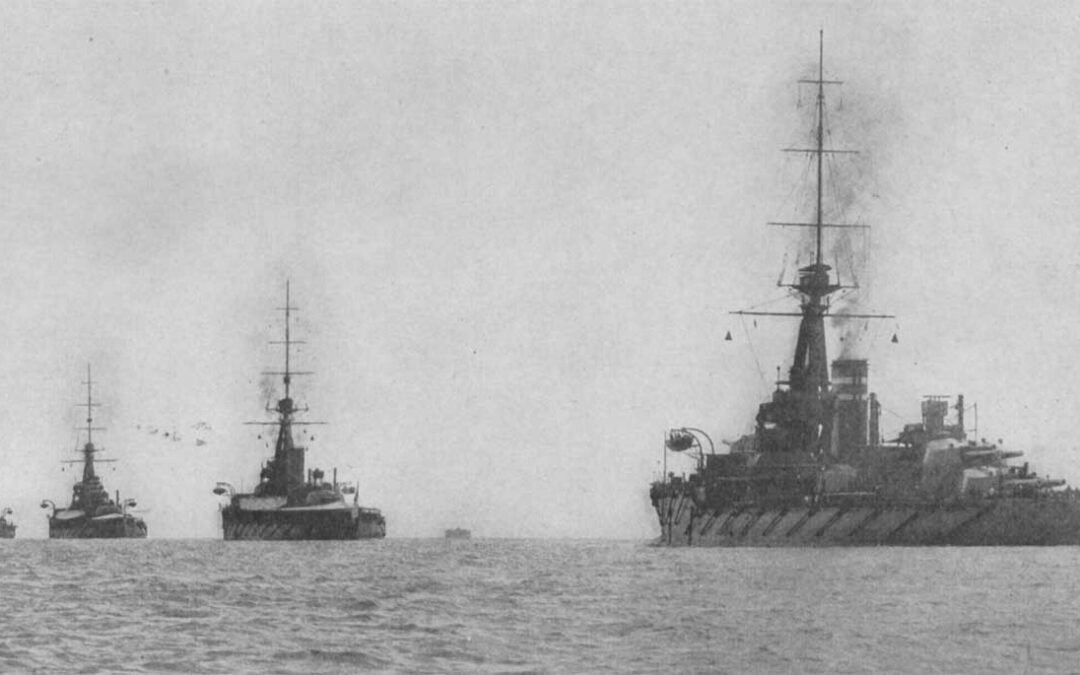
In 1914 the British engineer and polymath Frederick Lanchester came up with a set of equations that put numbers to superior fire power in any military action. This led to a startling conclusion, one already known intuitively to naval commanders of the day, but which was given specific numbers by Lanchester’s mathematics.
At the time the popular assumption was that, all other things being equal, a smaller force would do roughly proportionate damage to the larger. A fleet of 10 battleships, facing a fleet of 20, would supposedly sink about 10 of the enemy before being defeated, and so on. This was one of the reasons why news media around Britain’s far-flung Empire sometimes declared that HMS Dreadnought, which had an 8-gun broadside, had twice the power of a King Edward VII class battleship with a 4-gun broadside.[1] This idea, however, was already known to be wrong in naval circles. Experience during the age of sail had shown that a superior fleet – or one able to bring superior fire to bear on a portion of the enemy, as Nelson did at Trafalgar – could inflict disproportionate damage. That also seemed true for the steel and steam battleships of the industrial age. US Navy Commander Bradley A. Fiske penned a prize-winning paper in late 1904 showing that the superior fleet would get a clear advantage, and proposing the twin turret as a ‘unit’ to calculate fire-power.[2] Subsequent insights from Tsushima in 1905, where a Japanese concentration of fire on a small part of the Russian battle line tipped the balance, seemed to confirm the concept.
Lanchester put numbers to this phenomenon, mathematically showing that an inferior force would suffer an accelerating loss rate, and could never inflict equivalent damage. The fighting strength of any force was proportional – as he put it – to the ‘square of its numerical strength, multiplied by the fighting value of its individual units.’[3] As an example, if we assume all battleships involved in a battle to have a fighting value of 1, then a fleet of 20 battleships has a fighting strength four times that of a fleet of 10 vessels, not double.[4] Lanchester called it the ‘n-squared law’. The same rule dictated that a superior fleet had to be concentrated, or it would lose its advantage to a disproportionate extent. Lanchester explored the implication at tactical level, drawing on the age of sail for examples. At Trafalgar in 1805, Nelson – with an inferior fleet – split the enemy line by bold manoeuvre, reducing French power by the square root of the numbers involved. Lanchester concluded that Nelson ‘if not actually acquainted with the n-square law, must have had some equivalent basis on which to figure his tactical values.’[5]
Lanchester showed how his ideas also applied to armies and went on to apply his thinking to aircraft. However, the book-length study he published in 1916 included the naval side, which he recognised as a purer form of the idea because there was ‘no advantage to the defender analogous to that secured by the entrenchment of infantry.’[6] He also realised that Nelson must have had an intuitive grasp of the phenomenon. As it happened the same was also true for officers of the dreadnought era – an understanding that underpinned the plan to concentrate the majority of their capital ships in a single fleet when war broke out. Now Lanchester had shown there was real mathematics behind it. Admiral Sir John Jellicoe, among other officers, became adherents.[7]
Problems with the theory
Lanchester’s ideas also applied to the challenge Jellicoe then faced, the pressure to split that fleet. This was ordered for various reasons, including having supporting forces closer to Vice-Admiral Sir David Beatty’s Battle Cruiser Force which was based at Rosyth. The risk of this approach became clear on 16 December 1914 when six super-dreadnoughts of the Second Battle Squadron under Vice-Admiral Sir George Warrender came close to encountering the 14 dreadnoughts and 8 older battleships of the High Seas Fleet, backed by lighter forces that included 54 destroyers.[8] It was a near miss. Afterwards the mood aboard the British ships was defiant, and years later one Royal Marine aboard HMS Orion felt that ‘we would have given a good account of ourselves’.[9]
But opinion in the Admiralty was less sanguine, and Jellicoe knew very well that the British had dodged a bullet. Aside from their massive fire-power superiority the Germans had capacity to launch mass torpedo attacks, and Warrender’s super-dreadnoughts had only minimal underwater protection. It is worth noting that HMS Marlborough, struck by one torpedo at Jutland, then had issues with all main guns because once the list reached 7 degrees shells in all turrets slipped forward and fouled the shell brakes. These were shortly cleared, but A and B turrets did not fire afterwards due to concerns over the torpedo damage.[10] In short, torpedo damage alone could alter the Lanchestrian fire-power calculation.
We can apply Lanchester’s mathematics to the forces of 16 December 1914. Let us follow Fiske and take the fighting unit as the twin turret, and let us assume that each battleship will be firing broadside, noting the hexagon arrangement shared by eight German dreadnoughts that produced a 4-turret broadside. Because the British 13.5-inch gun fired markedly heavier shells than German 12- and 11-inch weapons, let us assign a fighting value of 1.45 to each turret of the six super-dreadnoughts.[11] The Lanchestrian force value is thus:
British: super-dreadnoughts (6 ships x 5 turrets at fighting value 1.45) 43.5
German: dreadnoughts (8 ships x 4 turret broadside + 6 ships x 5-turret broadside + 8 ships x 2 turret broadside at fighting value 1) 78
To these fighting values we apply Lanchester’s n-squared law, giving total fighting strength (rounded to nearest whole number) of 6084 German vs 1892 British, a superiority of 3.2 to 1.
In short, the Second Battle Squadron was going to be overwhelmed. But this calculation also shows up the problems with Lanchester’s model. The core principle is correct, but the assumptions detailing it are necessarily simplistic, similar to the old physics joke about calculating the volume of a cow by first suppposing it is spherical. For example, I did not assign variables to the 12-inch (892 lb shell) and 11-inch (665.8 lb shell) German guns, nor to the differing rates of fire by all weapons involved. The calculation also assumes perfect broadside fire and perfect fire-control.[12] In short, Lanchester’s basic idea is sound, but problems emerge when detailing it.
Lanchester was well aware of these issues in general and concluded that the ‘fairer comparison’ was the ‘energy per minute’ a ship could deliver.[13] This got around real-world variables such as differing heavy gun calibre, shell kinetic energy and bursting charges, rendering the combination to a single number involving delivered energy. Even so, that could only calculate the energy dispensed, not the energy received. And the fact was that in 1914 most heavy shells failed to hit their target.
Lanchester was not the only analyst wondering about this particular problem. Did anybody else have a better idea? In his 1904 essay Fiske proposed the twin turret with heavy guns as a basic naval force unit.[14] If we apply this to HMS Dreadnought versus the preceding Lord Nelson class the result is interesting. Dreadnought could bring four 12-inch turrets to bear on the broadside, versus two of Lord Nelson. In Fiskeian terms this gave Dreadnought a fighting value of 42, versus the 22 of the older vessel – a ratio of 16:4, not the 2:1 that featured in early public discussions. The same is also true in Lanchestrian ‘energy’ terms, because both ships had 12-inch guns and mountings of the same design. But ships with markedly different main armament were another matter.
None of this undermines the point that, had Warrender’s force run into the High Seas Fleet that dramatic day in December 1914, the likely outcome would have been loss of British naval superiority in the North Sea.
Lanchester’s equations and naval historians
We have seen that Lanchester’s ideas were sound in principle but hard to apply in practise. Can his equations nonetheless be used to support historical analysis? Mathematical studies along these lines have been done for the battles of Dogger Bank and Jutland, both by the same small team of British academics.[15] Jutland deserves an article of its own, so we’ll look at the Dogger Bank analysis for now.
That battle, fought in January 1915, was the first clash between heavy ships of the dreadnought age. As the First Lord of the Admiralty observed at the time, by contrast with the Napoleonic era, where sailing warships had centuries of precedent, nobody knew what would happen when the new industrial-age products of steam and steel collided.[16] The battle primarily consisted of a stern chase in which Beatty’s five-ship battlecruiser force pursued a four-ship German battle line that included the large armoured cruiser Blucher. This was disabled by a lucky hit from HMS New Zealand and subsequently sunk,[17] but the battlecruisers Seydlitz, Moltke and Derfflinger got away. Britain, by contrast, lost no ships although Lion was heavily damaged and forced out of line.
The received truth at the time is that the British were robbed of a crushing victory because a signalling mix-up caused Rear-Admiral Archibald Moore to lead the whole British squadron to attack the crippled Blucher, allowing the rest of Hipper’s force to escape. The First Sea Lord, Admiral Sir John Fisher, blamed Captain Henry Pelly of HMS Tiger, the lead British ship after Lion dropped out, for complying while the main enemy was running away: ‘Any fool can obey orders!’[18]
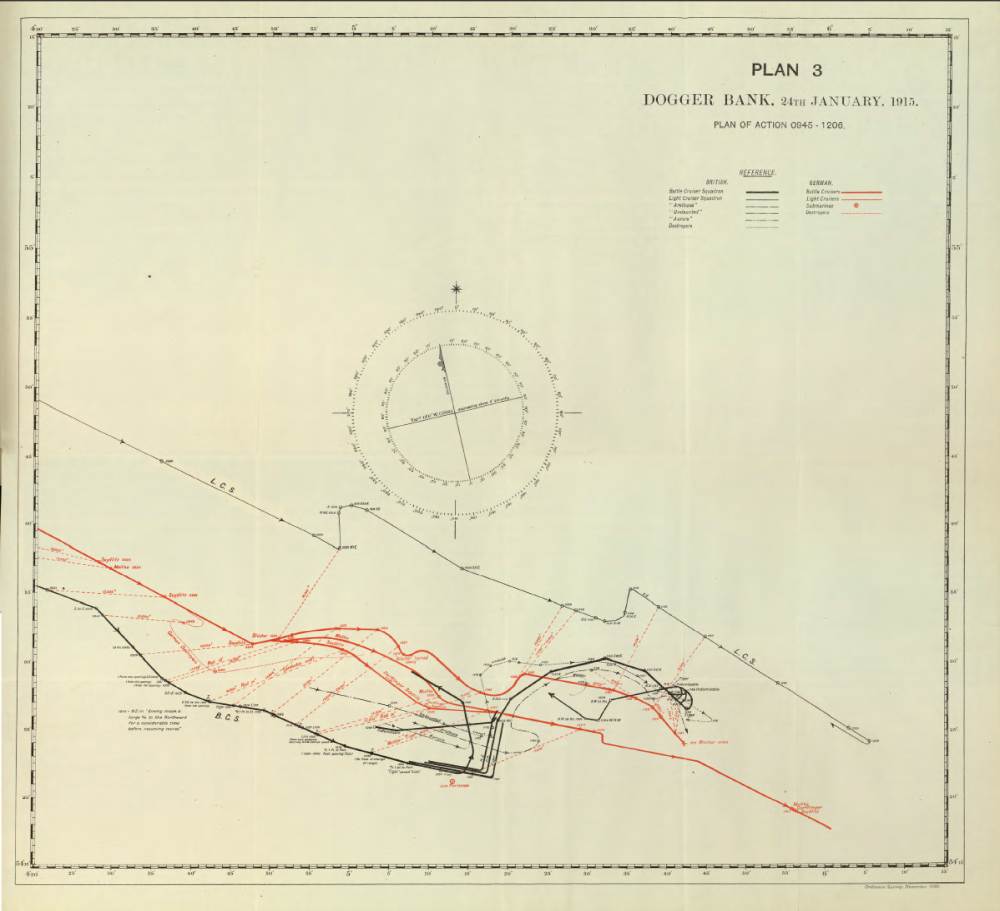
This counter-factual engaged with Royal Navy tradition, was in line with period expectation, and has featured in historical work since. However, the assumption was questioned by analysts Niall MacKay, Christopher Price and A. Jamie Wood, who pointed out that it was a post-hoc fallacy.[19] In other words, the fact that the British abandoned the chase did not mean they had also abandoned a sure victory. In order to develop credible counter-factuals, MacKay, Price and Wood analysed the battle using Lanchestrian principles to measure weight of fire from each side. All the ships involved deployed their main armament in twin turrets, so their Lanchestrian unit was the turret. A mathematical model was then built to include this along with a range of variables, using approximate Bayesian computation,[20] with Markov Chain Monte Carlo statistical methods.[21] So there was mathematics behind the study, accounting for more than just differential fire-power via Lanchester’s n-squared equation. The results were surprising. According to this analysis the events of the day were a fluke. The more common result, statistically, was the loss of at least one British capital ship, and up to three.
This was a remarkable study. With the benefit of knowing how heavy ships of the dreadnought era actually performed, backed by robust mathematical tools, these analysts provided a credible way of exploring counter-factual outcomes, buoyed by Lanchester’s n-squared model. But even this relied on assumptions that had to be assigned. Change those assumptions even a little and the range of outcomes, by definition, also changes. Nonetheless, the study clearly showed that the specific counter-factual of the day – that Moore had thrown away victory by abandoning the chase – was not a likely outcome.
Lanchestrian analysis in twenty-first century naval warfare
Lanchestrian force analysis seemed compelling to some naval officers in the early years of the twentieth century, a time when scientists were putting numbers to many different phenomena. The whole human world, it seemed, could be given ‘scientific’ validity through numbers. But as time went on it turned out that classic big-gun naval battles were one of the few areas where Lanchester’s thinking could be readily applied, and even then there were problems, as we have seen in this article. Lanchester, as we have also seen, was well aware of the issues.[22] From this perspective his mathematics were a useful adjunct, but not the sole way in which commanding officers analysed the tactical and strategic problems of the day.
However, Lanchester had hit upon a clear principle and in recent years his idea has re-emerged in association with naval missile warfare. Guided missiles are relatively straight-forward to model in n-squared terms. By nature they eliminate many of the variables associated with big guns, including loss of fire power while manoeuvering. Of course they carry their own variables. But this has not stopped the application of Lanchester’s principles in recent academic study. One example is Wayne Hughes’ salvo combat model, developed in the US Naval Postgraduate School in California. Another example of recent work is a 2017 study from the same school on the way Lanchester’s principles apply to a three-way fight.[23] The picture is clear. More than a century on, Lanchester’s basic ideas about differential fire-power still have merit as an analytical tool.. The issue, as always, is how that tool is applied.
Matthew Wright is a professional historian and a Fellow of the Royal Historical Society at University College, London. Buy his monograph Battleships by Constraint: the forces shaping Britain’s last generation of capital ships from Amazon.
Copyright © Matthew Wright 2026
[1] See, e.g. New Zealand Herald, 3 March 1906 [syndicated]
[2] Cmdr Bradley A. Fiske, USN, ‘American Naval Policy;, Prize Essay, 1 January 1905, Proceedings of the US Naval Institute, Vol.31/1/113.
[3] F. W. Lanchester, Aircraft in Warfare: the dawn of the fourth arm, Constable, London, 1916, p. 48.
[4] The equation can be written as n2 x fv = fs, where n is the number of units, fv is fighting value of each individual unit and fs is fighting strength of the whole force, ie: 202 x 1 = 400, 102 x 1 = 100, 400/100 = 4
[5] Lanchester, pp. 62-66
[6] Frederick Lanchester, ‘Aircraft in Warfare: the dawn of the fourth arm’, Constable & Co., London 1916, p.57.
[7] See, e.g. Niall MacKay, A. Jamie Wood and Christopher Price, ‘Maths swayed the battle of Jutland – and helped Britain keep control of the seas’, 2016, https://theconversation.com/maths-swayed-the-battle-of-jutland-and-helped-britain-keep-control-of-the-seas-59760
[8] Robert K. Massie, Castles of Steel, Pimlico, London 2005, p. 336.
[9] H. C. Wright to author, pers. comm.
[10] At Jutland, a single torpedo hit on HMS Marlborough blew a hole 20 x 26 feet and distorted plating across multiple frames, holing inner and outer bottoms.Two men were killed instantly and others injured. She listed 7 degrees and continued to ship water, flooding ‘A’ boiler room. She was forced to return to harbour, but even this was not without trouble. Problems with the pumps prevented the space being fully dewatered and at 10.00 pm on 1 June the XO, Commander H. S. Currey, asked Captain George Ross to call for a salvage tug. See Battle of Jutland: official despatches, HMSO, London, pp. 69-70, 100-107.
[11] This is not random, I calculated it as follows. Warrender had three super-dreadnoughts firing the 1,400 lb ‘heavy’ 13.5-inch shell and three firing the original 1,250 lb version. On average this was 1.45 times the weight of the German 12-inch shells at 892-lb, which were deployed by ten of the 14 German dreadnoughts.
[12] For analysis of period fire control see Matthew Wright, The Battlecruiser New Zealand: A Gift to Empire (USNI Press, 2021), pp. 133-137.
[13] Lanchester, p. 59.
[14] Fiske, section ‘Units of offensive and defensive power’.
[15] See, e.g. Niall MacKay, Christopher Price and A. Jamie Wood, ‘Weight of shell must tell: a Lanchestrian reappraisal of the battle of Jutland’, University of York, 2016, https://onlinelibrary.wiley.com/doi/10.1111/1468-229X.12241
[16] Churchill, The World Crisis, pp. 379-380.
[17] Wright, The Battlecruiser New Zealand, p. 146.
[18] Cited in
[19] N.J.MacKay, C. Price, A.J. Wood, ‘Weighing the fog of war: illustrating the power of Bayesian methods for historical analysis through the battle of the Dogger Bank’, 2016, Historical Methods: A journal of quantitative and interdisciplinary history, https://www.tandfonline.com/doi/full/10.1080/01615440.2015.1072071
[20] In 1763 Thomas Bayes devised a mathematical system for obtaining the probability of a cause from its known effects.
[21] Ie: a method for mathematically sampling probability distribution, which is useful in estimating Bayesian posteriors. It differs from other methods such as rejection sampling and importance sampling.
[22] Lanchester, pp. 39-66.
[23] Moshe Kress, et al, ‘Lanchester model for three-way combat’, 7 July 2017 [pre-print]

Recent Comments