
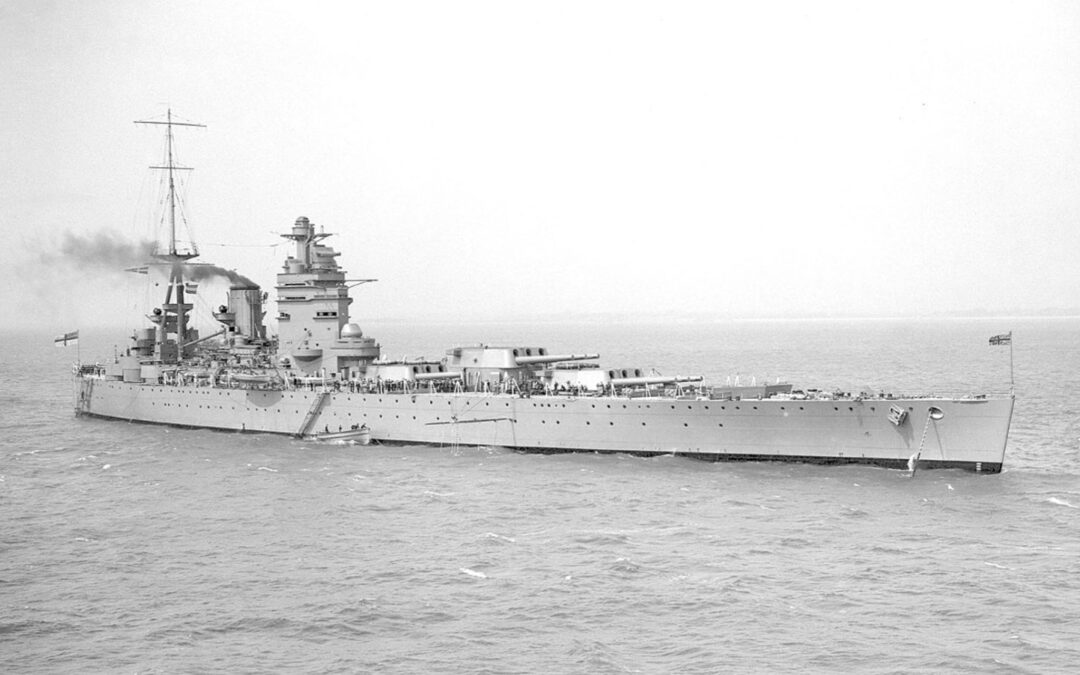
One of the stories that circulated in the Royal Navy after HMS Rodney was involved in sinking the German battleship Bismarck in May 1941 was that the British vessel had reached 25 knots during the pursuit, about two knots over her design capability of 23. The crew pointed to the extraordinary efforts they had made to wring power out of boilers that were well overdue for retubing. The claim has been made online and repeated in some naval forums as if true.[1]
It’s a dramatic tale, and we’ll come to the reasons why it was told. But it’s not literally true. Aside from the documentary record showing how fast Rodney sailed during the pursuit, physics says no. The power-to-speed relationship for a ship is P∝V3. It’s a killer relationship where doubling the top speed requires eight times the power. This also feeds into the mathematics wrapped around ship speed calculations, notably the equation P=kV3, where P is power, V velocity and k is calculated from a variety of factors associated with the vessel’s hydrodynamic design, propeller resistance, and displacement.
On that basis, if 23 knots requires 45,000 horsepower – the values Rodney was designed for – then 25 knots given the same displacement, hull conditions and so forth, will require 57,600 horsepower. In short, and without any other change, Rodney would require a 28 percent power increase above design capacity for those two extra knots. British steam plants typically had elements of overdesign built in, but not that much.
The main problem in May 1941 was that Rodney wasn’t new. In fact, her propulsion plant was in dire trouble and tests earlier in the year showed that her top speed had dropped to 20 knots. This meant that her plant could now produce only two thirds its original output. In short, she was not able to make her design speed. There is no possibility that Rodney could have achieved 25 knots when chasing Bismarck – indeed, she couldn’t have done so even when new. The real question is not whether Rodney achieved a speed over design, but how she managed to push her plant to produce the 22 knots she was observed to make for about six hours from the afternoon of 26 May. Still, the ’25 knot’ story, along with variants that assign even higher speeds to the ship, didn’t emerge from a vacuum. So what was going on?
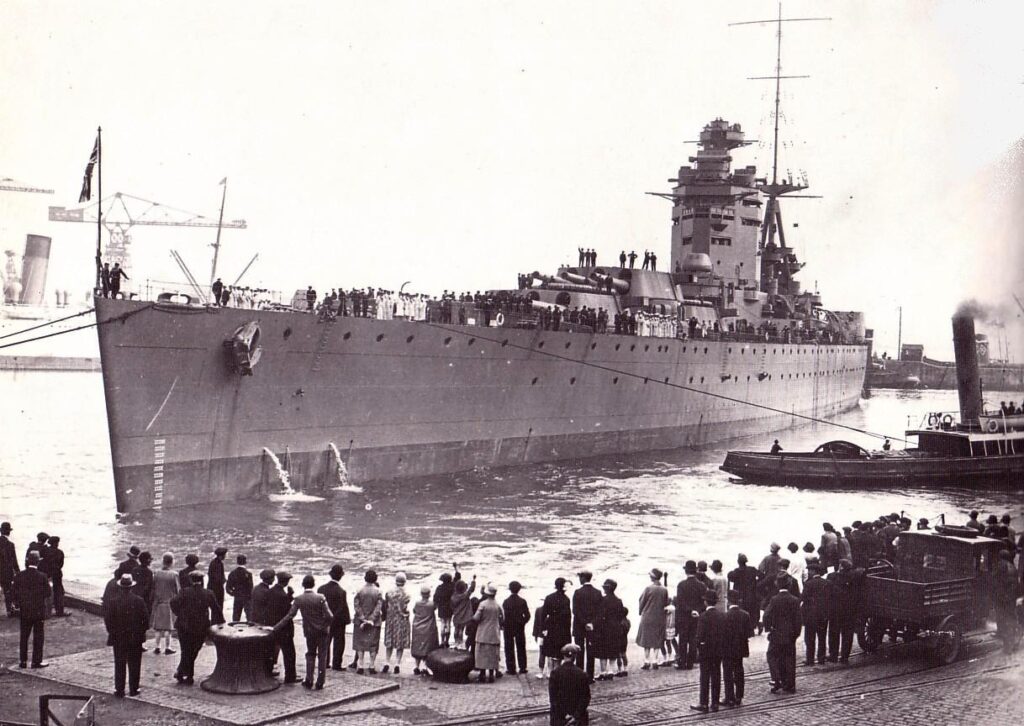
To put all this in place, we need to cast back to the origins of this battleship. Rodney emerged from the Five Power Treaty (‘Washington Treaty’) of early 1922. This allowed Britain to build two new capital ships, to a treaty displacement limitation of 35,000 tons. Up to this point, the British had intended to build four fast ‘G3’ battlecruisers of about 48,500 tons displacement, possibly followed by four ‘N3’ class battleships of similar displacement, but with heavier armament and reduced speed. For political reasons, any new ships built under treaty constraints would need to be in a similar league to the cancelled vessels, but shoehorning the ideal mix into about seventy percent the earlier displacement was challenging.
Design work began in December 1921, before the treaty had been signed, but after it was clear from negotiations in Washington that proposals to reduce displacement to 35,000 tons would be carried. Initially, the Director of Naval Construction, Sir Eustace Tennyson D’Eyncourt, assumed that any new ships would be battlecruisers and revived an older design, F2. After some iteration this emerged as design F3, a 29 knot ship with a 12-inch inclined armoured belt and nine 15-inch guns. However, there were political reasons to run with 16-inch guns and the First Sea Lord, Admiral Sir David Beatty, insisted upon them. This could be achieved by slashing the horsepower, producing a 23-knot battleship. This was the Admiralty’s standard speed for such vessels, and although just two knots more than HMS Dreadnought of the 1905-06 programme it was not considered slow by period values. The US Navy, for example, still operated a 21-knot battle-line, and newer Japanese battleships were then thought to be capable of only 23 knots.
What followed was labelled design O3, the next in the battleship sequence. Initial sketch estimates put the weight of propulsion plant and engineering stores, less feed-water, at 2600 tons for a 23-knot vessel. This was eventually reduced to a maximum of 2000, meaning that the final propulsion plant was relatively light for its power. Special attention was paid to the usual problem of weight creep during design finalisation, limiting any actual propulsion plant increase to only about 50 tons over the paper figures.[2] On the positive side, both ships benefited from work done during 1920-21 to optimise the underwater lines of Britain’s cancelled G3 and N3 class capital ships. An optimal underwater hull design meant they made best use of their available power – and with an intended output of just 45,000 horsepower from eight 3-drum Admiralty boilers operating at 260 psi, that efficiency was essential.
Rodney’s initial performance was essentially ‘to spec’: during trials in September 1927 she achieved 23.8 knots at 45,614 horsepower. But she could only maintain optimal conditions for so long. At the time the Admiralty assumed a reliable lifespan of about 10 years for a typical marine boiler installation. However, battleships were expected to last 20 years. This had been codified in the Five Power Treaty (‘Washington Treaty’) of 1922, but it was also a practical figure given the pace of engineering change, wear and tear on hulls and so forth. This implied that ships would receive a mid-life rebuild or ‘large repair’ that included boiler replacement and other work. The Admiralty began modernising their fleet in the early 1930s, a process hampered by restrictive budgets and limited engineering capacities. Nelson and Rodney were the newest battleships and at the end of the queue, but late in 1937 the DNC’s office began considering initial ideas.
One of the major problems with the two ships was their speed: this had been adequate by early 1920s standards, but battleship speeds rose sharply during the 1930s and the Nelsons were now looking distinctly slow. Proposals eventually included a scheme to reboiler and re-engine both battleships for 25.5 knots at a nominal 35,000 tons. To achieve that they would require 70,000 horsepower, some 55 percent greater than the original propulsion plant was designed for. This concept was bandied around the Admiralty for some months from June 1938. A significant rebuild with new superstructure, 5.25-inch secondary guns and the increased propulsion plant was approved in September. That scheme lasted until March 1939 when it was replaced with a cheaper plan, though apparently still involving the same propulsion plant replacement for a speed of 25.5 knots.
Just when this might be done was unclear, and the plan was soon overtaken by events. This was unfortunate. By 1939 it was clear that Rodney was going to need major propulsion plant maintenance. During a ‘wear and waste’ test in August that year her boiler tubes were estimated to have just twelve months’ life remaining.[3] But war broke out a few weeks later, and neither Rodney or her sister ship Nelson could be taken out of service for long. As a result Rodney soldiered on. Her boiler tubes were well past normal life by March 1941 when endurance trials revealed that hertop speed had dropped to about 20 knots. As we saw earlier this meant that her plant was only producing about two thirds – specifically, 65.75 percent – of its design power. One of her turbines then broke down, and when she sailed for Scapa at the beginning of May she needed repairs before she could safely sail to the United States for a full refit. Twenty knots remained her practical best speed when she finally set out for Boston on 21 May, an issue Captain F. G. W. Dalrymple-Hamilton had to keep in mind when intercepting Bismarck.
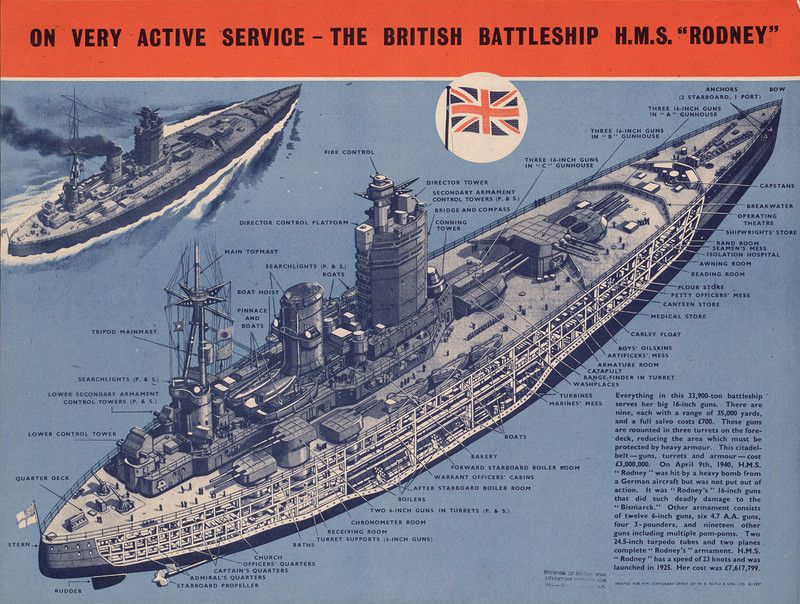
The records – conveniently packaged along with official reports and diary excerpts by the US Naval Attache on board, Joseph Wellings – make clear what speeds Rodney was ordered to achieve during the pursuit, and the speeds she actually managed. The battleship departed Glasgow on 21 May, escorting Britannic at 18 knots with destroyers in company. By 23 May the weather was so bad they had to slow to 13 knots, mainly to allow the destroyers to keep formation.[4] At 1022 hours on 24 May, about four hours after news of Hood’s loss, Rodney was given Bismarck’s last known position and ordered to close in.[5] Dalrymple-Hamilton did so at 20 knots, his best reliable speed, reporting that same speed to the Admiralty at 1428 hours that day.[6]
The ship maintained 20 knots, despite rough weather, into the early hours of the following morning,[7] and was still doing so at 0420 hours on 25 May when signals arrived from Suffolk advising that they had lost touch with the German battleship.[8] Dalrymple-Hamilton set up an ad-hoc advisory committee that included Wellings, and decided to loiter at low speed in his current area until specific information arrived. Later he decided that Bismarck was probably heading for a port in the Bay of Biscay. At 1040 hours he ordered 17 knots, later increasing this to 20. Then he ordered 21, which was within the ship’s original design parameters but more than the steam plant was capable of by then. But speed was essential, and the engineering crews got to work, pushing the ageing boilers to produce something closer to their original design output. In consultation with Wellings and Rodney’s navigator, Lieutenant-Commander George Gatacre RAN, Dalrymple-Hamilton then steered at 21 knots to intercept Bismarck on the Admiralty’s assumption that she was heading for Brest.[9] At 1134 hours on 26 May, Dalrymple-Hamilton reported that Rodney was making 21.6 knots, rising to 22 knots at 1449 hours. Six minutes later the lookouts sighted HMS King George V some 15 miles distant on a converging course.[10]
This speed was within original design parameters. But it required the ship to develop 87.5 percent of its design horsepower, well above the two-thirds level to which Rodney’s plant had deteriorated by this point. Getting there demanded special efforts by the engineering staff, and one boiler apparently broke down altogether, requiring running repairs by a sailor who had to work in temperatures of 124 degrees F. It seems likely that the legend of ’25 knots’ arose during this push to sustain 21-22 knots. The engineering crews were performing miracles, squeezing more power out of the boilers than they could sustainably deliver by May 1941. The historically noteworthy point is that Rodney was still making 22 knots at 1544 hours, as she slowly closed with the Home Fleet flagship.[11] The fact that she was able to press her dilapitated propulsion plant to this extent for so many hours is a testament to her engineering crews. By this time King George V had been forced to reduce to 22 knots to save fuel. At 1735 hours on 26 May, Dalrymple-Hamilton signalled by lamp that his own engine room conditions were ‘quite severe’ but he did not wish to slow down ‘since you may go on and I get left behind’.[12]
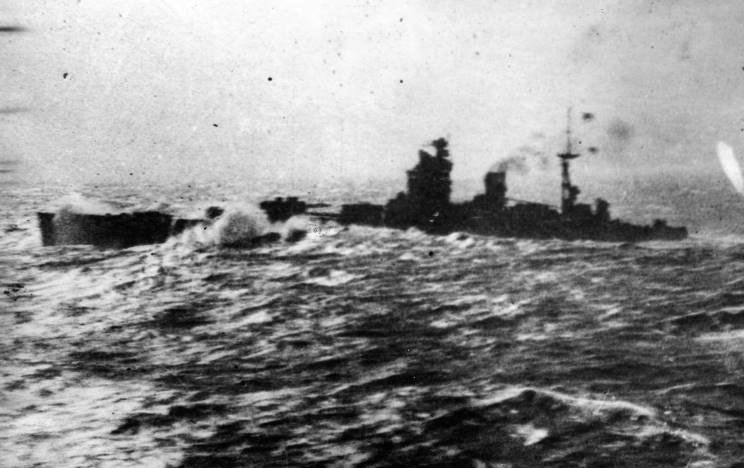
At this point Dalrymple-Hamilton believed his ship could maintain 22 knots, because at 1820 hours, Tovey asked him what speed he could make. On receiving confirmation, Tovey signalled the Admiralty to the effect that King George V would have to break off pursuit by midnight due to her fuel situation, but Rodney could carry on.[13] However, it shortly became clear that Rodney could not maintain 22 knots after all: lookouts aboard King George V noticed the older battleship falling back, and at 2028 hours Tovey signalled to Rodney that she did not have to keep station accurately. Dalrymple-Hamilton replied with a signal that, according to Wellings, read: “King George V’s 22 knots is a bit faster than Rodney’s and we are dropping distance.”[14] Tovey reduced to 21 knots,[15] which Rodney was able to make until 0030 hours on 27 May, when Tovey further reduced to 19 knots. This appears to have been a fuel-saving measure,[16] because by this point Bismarck was no longer steering for Brest and Tovey expected to engage her with both his battleships the following morning.
The signals make clear that at no time from first alert on 24 May to the moment when Rodney’s 16-inch guns fell silent on 27 May, did the battleship exceed 22 knots. To achieve that was still a remarkable achievement given that her maximum reliable speed had dropped to just 20 by this time. Furthermore – and clearly against the odds – Rodney maintained that 22 knots from about 1449 hours on 26 May until a little before 2028 hours the same day.
What did this mean? We have seen that by May 1941 Rodney’s propulsion plant was worn down to about two thirds of its original design output. To reach 22 knots required Rodney to produce 87.5 percent of that original output, meaning that her engineers had to coax it out of the decrepit steam plant – a figure within its original design, but about 22 percent more than her ageing boiler tubes really allowed by May 1941. It was a creditable achievement that speaks much for the capability of her engineering crew. The ’25 knots’ claim has to be seen in this context: Rodney’s crew knew they had performed miracles with a very shaky steam installation and, in this sense, the claim can be considered a metaphor. It wasn’t literally true, but it correctly captured the emotional feel of what they had achieved.
Matthew Wright is a professional historian and a Fellow of the Royal Historical Society at University College, London. Buy his book Ernest Rutherford and the birth of modern physics (Scribe, New York, 2025), available from any good bookstore or online.
Copyright © Matthew Wright 2026
[1] See, e.g. https://www.reddit.com/r/WarshipPorn/comments/7n7bvw/a_rare_photo_of_hms_rodney_as_she_braves_heavy/
[2] Noted in Friedman, The British Battleship, p. 241.
[3] ADM 1-10139 Battleship and Battle Cruiser Strength (1939), C. Talbot, Minute Sheet 14 August 1939.
[4] Wellings, Personal Diary, p. 189.
[5] Ibid, message logs, p. 197.
[6] Ibid, message logs, p. 198.
[7] Ibid, message logs, p. 204.
[8] Ibid, reminiscences MS, p. 204
[9] Ibid, reminiscences MS, p. 207.
[10] Ibid, signal logs, p. 214.
[11] Ibid, signal logs, p. 216.
[12] Ibid, signal logs, p. 217.
[13] Ibid, signal logs, p. 218.
[14] Ibid, signal logs, p. 219.
[15] Ibid, signal logs, p. 221.
[16] Ibid, signal logs, p. 222.

Recent Comments