
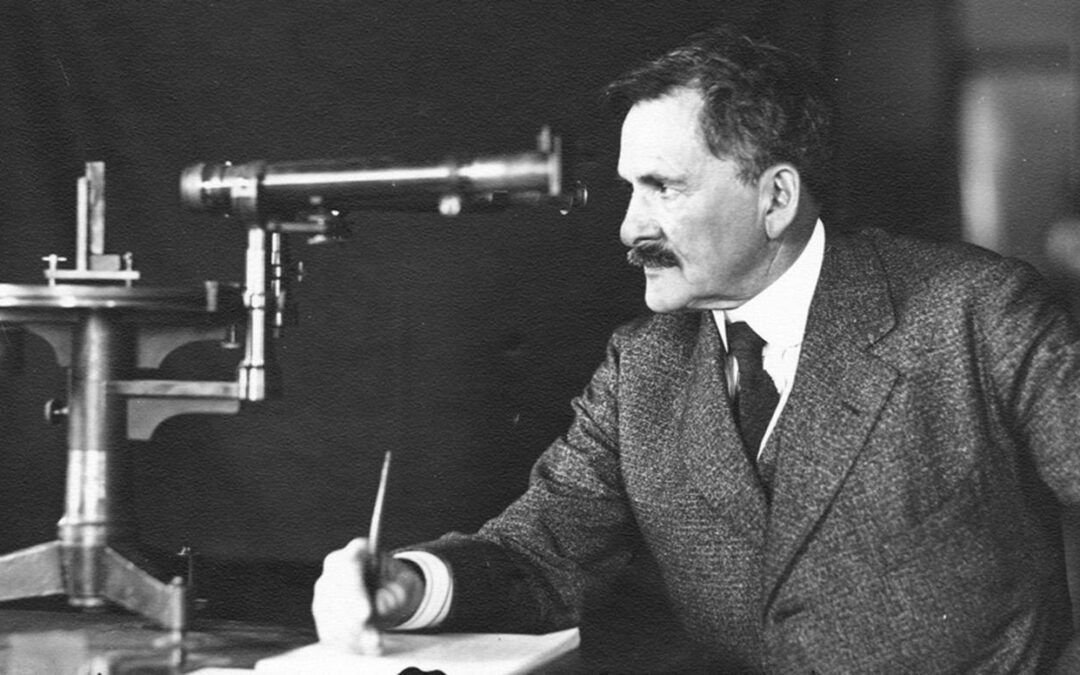
One day in January 1879 a 25-year old physics instructor at the United States Naval Academy at Annapolis began experiments with a curious apparatus set up along the north sea-wall of the academy grounds. This consisted of a rapidly spinning mirror, set up some 2000 feet away from an observing post inside a darkened building. From this vantage point the officer expected to derive a new and more refined value for the speed of light. This had been measured before, but not with the precision this officer intended to achieve.
The officer’s name was Albert Michelson. He had joined as a midshipman in 1869 and graduated from Annapolis in 1873. Now he was about to break new ground not just for the United States Navy, but for physics as a whole. By this time a revolution was under way, based on the phenomenon of electromagnetism, of which light was a component. The rate at which this travelled was an important step in the effort to understanding and thus exploit the new phenomenon.
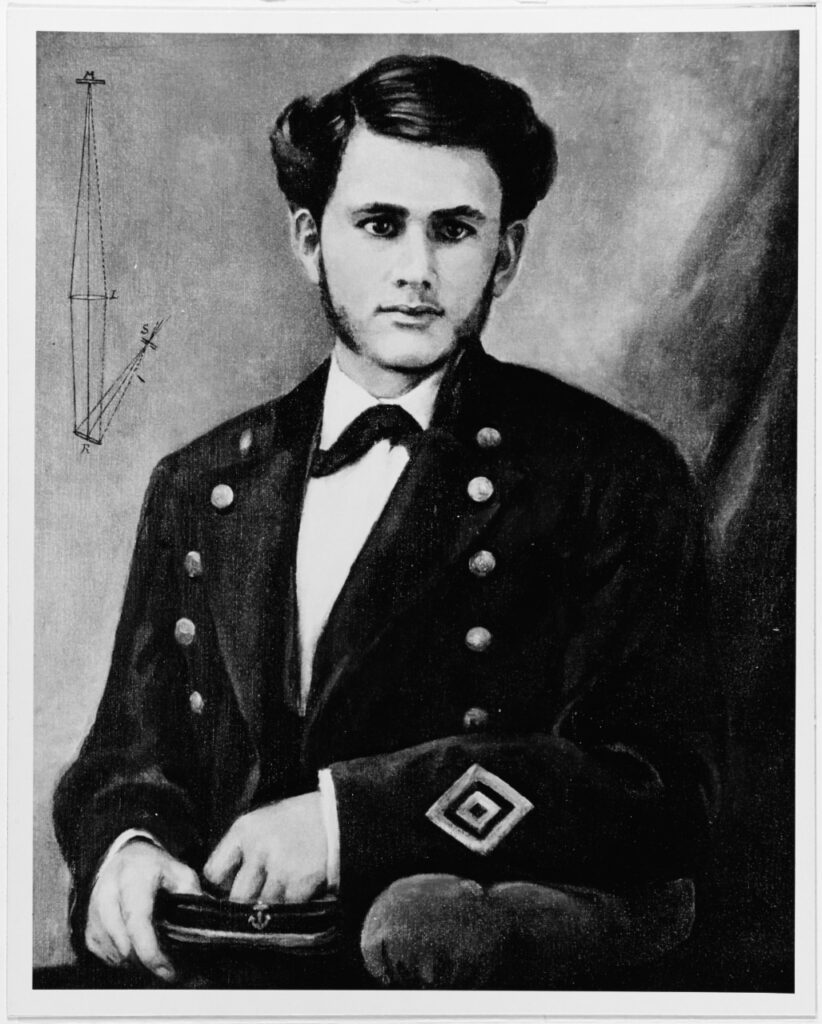
Michelson’s experiment began in late 1877 as a simple class demonstration. His technique involved a revolving mirror apparatus originally developed by the British physicist Charles Wheatstone in 1834, later used by the French physicist Léon Foucault to measure light-speed. Michelson spent $10 on a revolving mirror and set up an initial experiment with observing distance of some 500 feet in May 1878. This, he realised, was ‘very crude’, but ‘under great difficulties’ he made initial measurements of light-speed in air.[1] The effort stood outside the push to refine the same value by the mainstream academic science community, but it drew attention and Michelson was able to obtain a grant of $2000 for larger apparatus.
This was ready by the beginning of 1879. His new rig included a heliostat provided by the Army Medical Museum, and a mirror made by Fauth & Co of Washington that was able to revolve up to 250 times a second. The range of some 2000 feet required for observations demanded an outdoor location which Michelson describe as along the ‘north sea-wall of the Academy grounds’. Michelson went to considerable effort to precisely measure this distance, which he was able to determine ‘within one-hundredth of a millimetre’.[2] He spent some months on the work, making his first test measurements in January 1879, modifying the equipment, then continuing to work with and modify it. He made thirty attempts before he was satisfied, discarding all prior observations in favour of a new series beginning on 5 June. The times when he could make observations were limited to within an hour after sunrise or just before sunset: only then was the air still enough for him to see the mirror through his micrometer eye-piece.
From this experiment Michelson came up with a velocity for light now known to be some 200 times more accurate than prior figures.[3] This marked the first time the speed of light in air had been measured with such precision, an achievement that catapulted Michelson and the US Navy’s science programmes into the world physics spotlight. It was a significant achievement, all the more so because it stood outside the major physics programmes of the day. Simon Newcomb, then head of the Nautical Almanac Office, urged Michelson to produce a paper describing the experiments.[4]
It might seem odd that a naval officer was involved with the cutting edge of physics, but in fact it wasn’t. There were reasons why the US Naval Academy taught physics and chemistry, reasons why the navy operated a major observatory and weather centre, where Michelson went on to work later in 1879. Science was important to the naval forces of all the industrialised nations of the day on multiple levels, from finding better ways to navigate to forecasting weather systems. Keeping atop the latest technical developments was all the more crucial by the late nineteenth century, when new ways to exploit electromagnetism were being discovered at pace. The need to push tech limits wasn’t new: naval forces the world over had been keenly interested in finding ways to improve military technology since ancient times when galleys were the battleships of the age, Stories abound of wonder-weapons such as ‘Greek fire’. Later, when gunpowder and cannons were invented, it did not take long to fit them into warships. The point is particularly true, though, of the last couple of centuries.
The physics revolution that began during the second half of the nineteenth century pivoted around electromagnetics – one of the fundamental forces of the universe. Today this force sits behind modern technology and is the bread and butter of modern naval operations. Everything from radars, radio, control systems – indeed all onboard electronics in any modern warship – pivots off technologies that exploit electromagnetism and its properties. The potential this had to revolutionise technology was recognised even as the principles emerged in the early nineteenth century. Electromagnetics were given a mathematical treatment in the early 1860s by the Scottish physicist James Clerk Maxwell. New technologies followed, among them electric light and telephone – all of which found their way into warships. One of the earliest ironclads to be electrified was HMS Inflexible, which was designed in the mid-1870s and fitted with dynamos able to power electric lighting, among other tasks.
What wasn’t fully understood was how electromagnetism propagated. This question seized Michelson’s attention at the end of the 1870s. It wasn’t new: the issue had been around since the first western investigations into light during the second half of the seventeenth century. At that time a science revolution was under way in Europe, driven by new styles of thinking. Scientists such as Isaac Newton, Robert Hooke, Edmond Halley (as in the comet) and others.eagerly probed the mysteries of the universe. Newton looked into the nature of light, concluding that it consisted of tiny particles and therefore self-carried. However, Hooke disagreed, and so did the Dutch scientist Christiaan Huygens, who argued that because light could be diffracted it had to be a wave in a carrier medium, like a ripple on water.
From this emerged the idea of an intangible and invisible material, a ‘luminiferous aether’, which suffised everything and acted as a carrier medium for light. Newton initially disagreed on the basis that to explain something by imagining an invisible and undetectable material was stupid. But in the end he had to agree. Based on what they knew, this imagined ‘aether’ was the only explanation. Subsequent work seemed to prove the idea. In 1801 the physicist Thomas Young was able to produce interference patterns from a beam of diffracted light. This was possible only if light was a wave. Therefore the ‘aether’ had to exist, even if nobody could detect it. This discovery was given further weight in 1819 when the French engineer Augustin Fresnel – as in the ‘Fresnel lens’ – proved the point mathematically. Light, in short, was demonstrably a wave. The ‘aether’ therefore existed: QED.
The only problem was that there was no direct evidence of it whatsoever. This was the problem: by scientific principles the ‘aether’ had to be empriically measured in order to prove it was more than a theoretical phantom. One method was proposed by the British physicist George Stokes in the 1840s, who argued that if the ‘aether’ behaved like a normal fluid, it should create a headwind when Earth moved through it, creating a drag effect that should be measurable.[5] That idea was picked up by Maxwell in the 1870s. By this time physicists had demonstrated that light was part of the electromagnetic spectrum, electromagnetics had become the cutting edge of physics, and the need to empirically prove that ‘aether’ existed was becoming urgent. One way of measuring this ‘headwind’ was to time the eclipses of Jupiter’s moons, and in 1879 Maxwell wrote to the US Nautical Almanac Office – run by the US Navy – to see whether they could do this.
Michelson was working in the facility at the time and felt that a better way was to use an interferometer and try to detect Earth’s ‘aether drag’ directly. He reasoned that if he split a beam of light, sent one part off at a 90 degree angle, and then observed the interference pattern produced when it recombined, he should see a ‘fringing’ effect if one part of the beam was being slowed by ‘aether drag’ and the other part was not. The scale of fringing could be calculated mathematically ahead of time and then tested against actual observations. The reasoning was sound, but it took Michelson until 1881 to build a machine to do the job. By this time he was working at the Astrophysical University in Potsdam.[6] The experiment should have worked, but he couldn’t get a result.
By this time John Strutt, Lord Rayleigh, was in charge of the Cavendish Laboratory, Britain’s leading scientific establishment. Empirical proof of the ‘aether’ was of profound importance to physics and he urged Michelson to try again. Michelson concurred, but it took him six years to build better apparatus, this time with the help of the chemist Edward Morley. This was complete by early 1887. It was ten times the scale of his earlier machine and more sensitive. The device consisted of a stone block 1.5 metres square, floating in a pool of liquid mercury held in a circular iron tray. The tray was marked with graduations that enabled the former naval officer to turn the stone block to precise angles. At each corner of the block was a mirror, angled to reflect a split beam of light from an argand burner.[7]
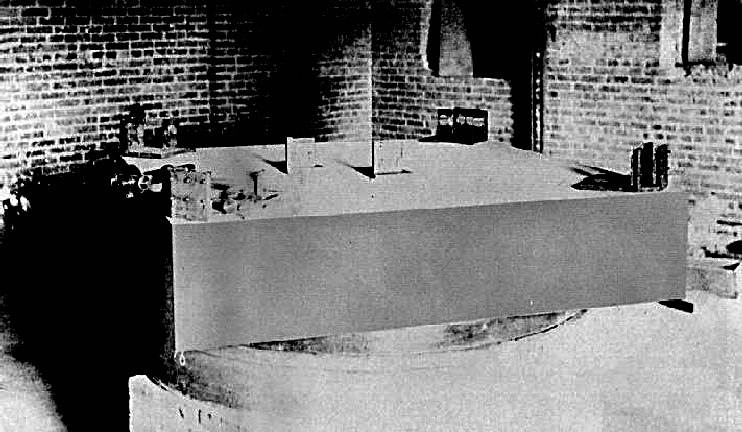
Their experiments began in April 1887 and lasted six months, in part because Michelson knew the Sun also moved, but nobody had yet measured its velocity.[8] By waiting until Earth had moved through part of its own orbit – changing the angle of its trajectory – he could account for the unknown value of the Sun’s own movement.
It was a bold effort, carefully planned and executed with great precision. Michelson had been well trained by the US Naval Academy, combining an excellent education with a sharp mind that made him one of the top physicists of his day. In the event the interferometer proved that the speed of light was identical in every direction. Maxwell had assumed it was a constant when devising his electromagnetic equations, and now Michelson had shown this to be true. That was useful information, but the experiment was otherwise a failure because it hadn’t detected ‘aether drag’. In short, the ‘aether’ didn’t exist. And that threw a spanner right through the centre of physics, because electromagnetic radiation demanded a carrier medium.
Efforts were then made to explain the null result in other ways. In 1889 the Irish physicist George FitzGerald came up with one answer. Oliver Heaviside had discovered that moving electromagnetic fields deformed in the direction of travel. At the time electromagnetism was thought to lie behind much of what was observed in the universe, so FitzGerald wondered whether this distortion also happened to ordinary matter? If that was the case, Michelson’s interferometer would have contracted in the direction of movement. This explained the null result without dispensing with the idea of an ‘aether’. The idea was also picked up by the Dutch physicist Hendrik Lorentz, who came to the same conclusion.
This was designed to preserve the idea of the ‘aether’ and was symptomatic of the way scientific paradigms based on a faulty premise break down. Efforts to prove them become increasingly desperate and complex until, finally, somebody comes up with a completely different idea. And this is what happened with the ‘aether’. In 1905 a 26-year old Swiss-German high-school dropout by the name of Albert Einstein solved the problem. He was working in the Berne patent office while moonlighting as a physicist, and that year published his doctoral thesis along with four papers that were simply revolutionary. One of those papers answered the mystery of the ‘photoelectric effect’ discovered by Heinrich Hertz some years earlier, proving that electromagnetism actually consisted of particles and was self-carrying. In short, there was no need for an ‘aether’. It was a remarkable discovery, overturning a two-century old belief. Oddly, while 1905 has been dubbed Einstein’s ‘miracle year’ – for it was by any measure – he remained virtually unknown until 1911 when Lorentz invited him to the first Solvay physics conference. Einstein eventually received the Nobel Prize for his explanation of the photoelectric effect.[9]

Michelson went on to a stellar career of his own. His work with interferometers, measurement and light-speed catapulted him to the top of the physics field, and in 1907 this former US naval officer was awarded a Nobel Prize in physics for his work in optical precision instruments and their contribution to spectroscopic and meterological investigation. He was awarded numerous honours, including the Matteuci Medal (1904), Copley Medal (1907), Elliott Cresson Medal (1912), Draper Medal (1916), Franklin Medal, and more. He was made President of the American Physical Society in 1900, of the American Association for the Advacement of Science in 1910, and of the National Academy of Sciences in 1927. Michelson published extensively on light and its properties, helped define the length of a standard metre in terms of wavelengths of light emitted by cadium, and then during the First World War returned to US Navy service. Here he worked on optical devices for naval use, including a rangefinder. Afterwards he returned again to civilian life and, in 1920, measured the diameter of Betelgeuse – the first time the diameter of a star had been measured.
Michelson, the former US Navy midshipman, died in 1931, a respected senior physicist who was unquestionably one of the greats of his day. In 1969 a major science building was dedicated to him at Annapolis, Michelson Hall. And in 2024 the United States Naval Academy was declared an American Physical Society Historic Site in recognition of Michelson’s work and naval origins.
Matthew Wright is a professional historian and a Fellow of the Royal Historical Society at University College, London. For more on modern physics buy his book Ernest Rutherford and the birth of modern physics (Scribe, New York, 2025/Oratia, Auckland 2025), available from any good bookstore or online.
Copyright © Matthew Wright 2025
[1] Albert A. Michelson, Master, USN, ‘Experimental Determination of the Velocity of Light made at the US Naval Academy, Annapolis’, https://www.gutenberg.org/files/11753/11753-h/11753-h.htm
[2] Albert A. Michelson, Master, USN, ‘Experimental Determination of the Velocity of Light made at the US Naval Academy, Annapolis’, https://www.gutenberg.org/files/11753/11753-h/11753-h.htm
[3] Noted in https://navalacademytourism.com/blog/usna-graduate-albert-michelson, accessed 4 September 2025.
[4] Ibid, introduction.
[5] G.G. Stokes, ‘On the Constitution of the Luminiferous Aether, viewed with reference to the phenomenon of Light’, Philosophical Magazine, Vol. 29, July–December 1846, pp. 6–10; also G.G. Stokes, ‘On the Constitution of the Luminiferous Aether’, Philosophical Magazine, Vol. 32, May 1848, pp. 343–49
[6] Hans J. Haubold, ‘Albert A. Michelson’s Experientum Crucis 1881 in Potsdam, Germany’, arxiv.org/pdf/2111.12176, accessed 26 September 2024.
[7] Albert A. Michelson and Edward W. Morley, ‘On the relative motion of the Earth and the luminiferous ether’, American Journal of Science, Vol. XXXIV, No. 203, November 1881, p. 387.
[8] Today the Sun’s net total velocity around the galaxy has been calculated to be some 220 km/sec, with a ‘peculiar velocity’ – that is, a velocity relative to the average velocity of nearby stars – of 19.7 km/sec.
[9] Matthew Wright, Ernest Rutherford and the Birth of Modern Physics, Scribe, London 2025, pp.138-139.

Recent Comments