
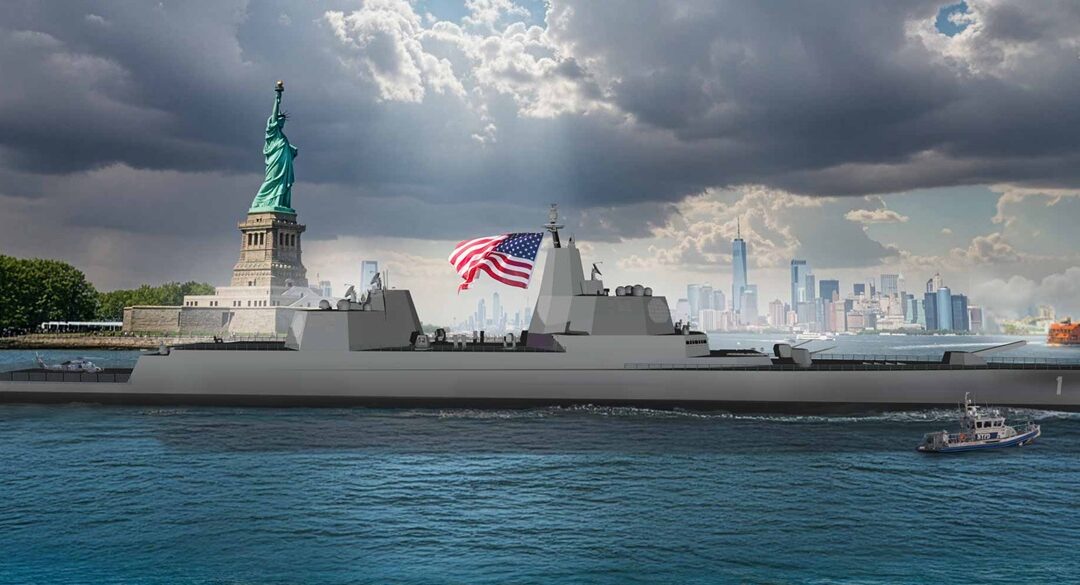
The recent announcement from the United States that it would resume building battleships – not the classic big-gun variety of the twentieth century, but a modern concept with advanced technology[1] – came as a surprise at a time when the largest surface combatants under serious consideration by any navy were guided missile destroyers.[2] One result on bringing back battleships has been a good deal of discussion, lately including professional think-tanks.[3]
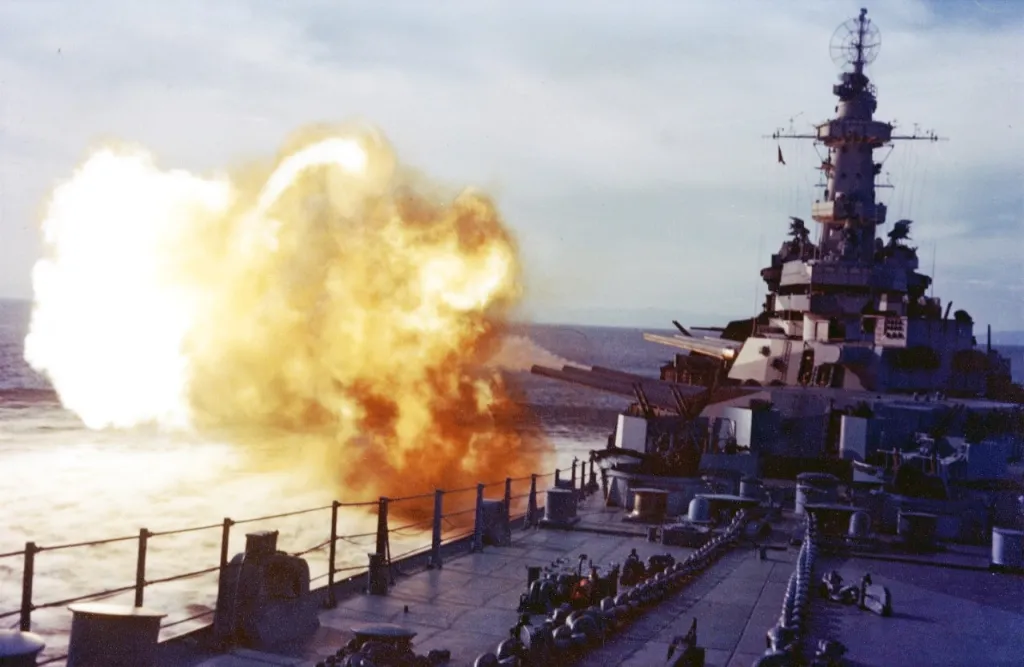
This article focuses on the broad parameters of this issue, which are not limited to any one navy and which relate instead to the general question of how to best develop twenty-first century sea power. The idea of reviving battleships is not new. In the early 1980s, the US Navy returned its Second World War vintage Iowas to service, primarily because of their unparalleled fire-support capability and potential for engaging large Soviet cruisers of the Project 1144 Orlan (Sea Eagle)/Kirov class.[4]
At popular level the emotional appeal of large and powerful warships remained. Even today the term carries emotional power. Classic big-gun battleships defined national sea power for half a century or more. A modern large surface combatant equipped with the latest rail guns, lasers and missile systems must, by definition, pack a bigger punch than a ship of a quarter its displacement. As is evident in Soviet Project 1144 Orlan class cruisers, large vessels also offer enhanced accommodation and crew facilities by comparison with smaller ships, a human factor as crucial to naval operations as any other aspect of ship design.[5]
The deeper question is whether any navy requires large surface combatants in an increasingly networked combat environment? If it is, can its cost be justified? At tactical level, is it sensible to concentrate that much power in a single hull? And is it practical for any nation to build large surface combatants, both in terms of ship-building capacity and naval budgets? The recent experience of the Royal Navy, where the decision to build and operate two large aircraft carriers forced reductions in strategic deterrent missile loads and early retirement of aircraft and major warships, is a case in point.[6] There is also the Russian experience with the Project 1144 Orlan/Kirov type, where costs delayed completion of one unit and forced others to be taken out of service relatively early in their expected careers.[7]
What is a battleship?
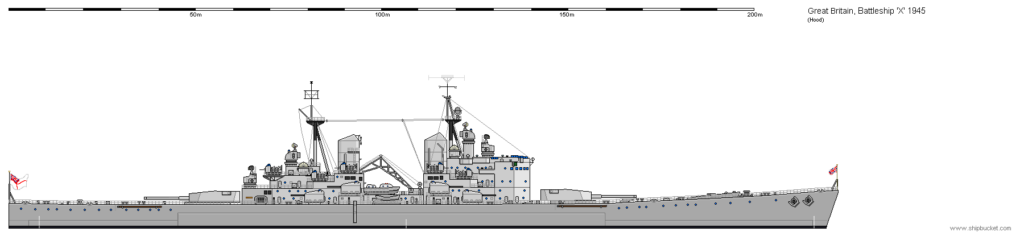
Ship classification has always been arbitrary, particularly during times of rapid development. The occasional disconnect between engineering characteristics and official label often provokes assertions in enthusiast forums and even professional studies to the effect that a warship is ‘really’ something other than its classification.[8] The usual examples are HMS Hood (1920) and the US Navy’s Alaska class. More recently Russian cruisers of the Project 1144 type have loosely been called ‘battlecruisers’, although their actual designation is ‘nuclear-powered heavy rocket-cruiser’.[9]
The more useful question is why navies made those decisions. Politics often intruded. A good example is the British heavy ship programme of 1904-05, where Admiral Sir John Fisher began with ideas for mid-sized warships that didn’t meet either a battleship or armoured cruiser classification, but was forced into that framework by pre-existing funding agreements built around those classifications. This resulted in two new designs – HMS Dreadnought and HMS Invincible – neither of which fully represented his original concept.[10] For more on that, check out this article. More recently, classifications have been used to elide political limits – notably the ‘through deck cruiser’ term the Royal Navy used in the 1970s to get around a ban on aircraft carriers. There is also the ‘destroyer’ classification applied by Japan to describe its recent light aircraft carriers, eliding post-war agreements regarding its naval self-defence force.[11]
From the tactical and operational perspective the key issue is how a warship is operated and fought, as dictated by the engineering specifications, irrespective of label. Navies routinely issue instructions to guide commanders, for example specifying never-exceed draft limits, or defining fighting instructions to best optimise military characteristics. What this means is that any discussion of modern surface combatants must focus on the expected function and the military characteristics a surface combatant requires to fulfil it. The question is whether a particular combination will work better in that role than a different combination – and at tactical level, that is the heart of the debate about ‘reviving’ battleships.
We can see this at work through history.The big-gun battleships of the twentieth century were designed to project sea force, but in this role were merely the latest incarnation of vessels filling that function. Classical Greek rowing galleys fulfilled that role in the ancient world, making them the ‘battleships’ of their day.[12] In the early modern western diaspora the role of ocean dominance fell to large wooden sailing vessels, and by the late seventeenth century naval tactics revolved around fleets of them fighting in lines.[13] From this emerged the terms ‘ship of the line’ and ‘line of battle ship’ to describe the first, second and third-rate warships built for that task.[14] Wooden walls and sail were replaced during the mid-late nineteenth century by steam-driven, steel-armoured warships. The term ‘battleship’ was adopted by the Royal Navy in 1887 to describe the largest of these new types, derived from ‘line of battle ship’.[15] It was initially two words, ‘battle ship’, popularised through cigarette cards. The one-word neologism ‘battleship’ was in common use by the early 1890s.
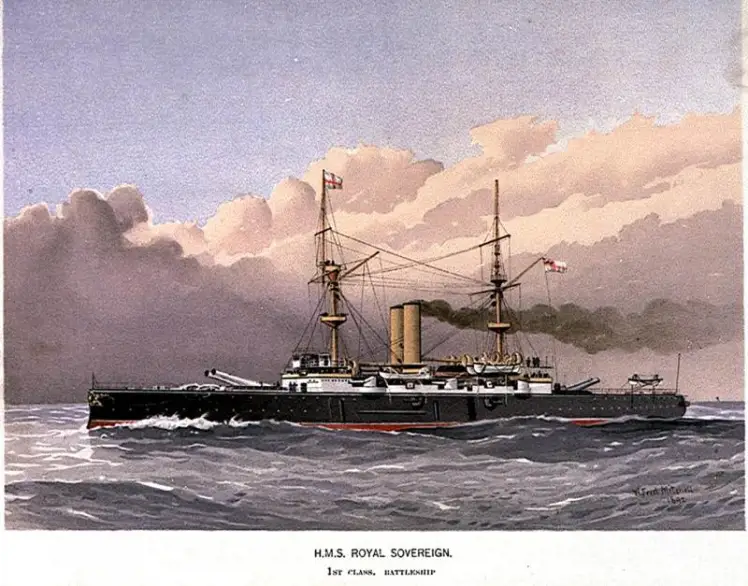
However, this did not mean a new type had emerged. British battleships of the late 1880s were an evolution of earlier ironclads, with identical function: securing command of the oceans. To this extent ‘battleship’ was arbitrary, underscored in the early 1900s when all-big-gun battleships gained the popular name ‘dreadnoughts’, a socially-mediated term that fell out of favour after the First World War. Curiously, ‘battleship’ was not adopted as a term by every navy. Germany called its early twentieth century battleships ‘linienschiffe’ – line ships – in another call-back to the old sailing terms. They did not adopt ‘schlachtschiffe’ – battleship – until the late 1930s, when it was applied to the Scharnhorst class.[16] In short the term, of itself, was arbitrary.
Why big-gun battleships faded
By the end of the Second World War it was clear that the arms race between offensive weaponry and armour protection had been won by weaponry. The British Admiralty hoped to build their delayed Lion class battleships once war was over, fully revised to incorporate war lessons. In reality there was no chance. By 1945 Britain was near-bankrupt – but, more crucially, no practical protection scheme could be devised to defeat the bombs now available.[17] This was a lesson Britain had delivered to Germany in the form of the 6-ton weapons that destroyed the battleship Tirpitz in late 1944. As analysts William Garzke and Robert Dulin observe, these far outstripped the design parameters of Tirpitz’ armour and underwater protection systems.[18]
This calculation got worse. In 1943, the Luftwaffe’s III/KG 100 bomber wing sank the Italian battleship Roma and damaged the US cruiser Savannah and British battleship Warspite with Fritz-X guided glide bombs.[19] The German military also pursued rockets as a viable weapon. Both technologies matured after the war, producing a new naval weapon: the guided missile. The Soviet Union began developing such weapons from the late 1940s, notably via the OKB-2/Raduga design bureau. One of the first surface combatants to exploit the new technologies was the Soviet Project 58 missile cruiser (NATO reporting name Kynda), for which design work began in 1956.[20] This replaced planned 30,000 ton Stalin class gun-armed battlecruisers with a cruiser of around 5,400 tons full load, but which nonetheless carried eight P-35 missiles in two quadruple SM-70 launchers.[21]
The picture was clear. Aircraft could project power to greater ranges than any gun. Missiles were gaining power and range. Into that came new-generation torpedoes, including wire-guided weapons that could be steered into a target. Heavy guns ceased to be the decisive naval weapon, while battleships became vulnerable to mission kill, potentially to outright loss. The outcome was a mix of aircraft carriers ranging up to about 100,000 tons, joined by amphibious ships up to about 40,000 tons or thereabouts. But surface combatants were smaller. Setting aside the outlier, the Soviet Project 1144 class of the late 1970s,[22] the majority of surface combatants were less than about 10-12,000 tons. Arguments for larger warships sometimes surfaced. So-called ‘arsenal ships’ – large vessels with hundreds of missiles but few other military facilities – were considered by a variety of navies from the 1980s.[23] But none were built at the time.
Still, all-big-gun battleships died hard. The French, British, Soviet Union and United States operated battleships for some years after the Second World War. Shore bombardment remained important, and the United States retained its Iowa class battleships in mothballs, reactivating USS New Jersey in 1968 for that purpose. All four Iowas were then brought back into service during the early 1980s, both for shore bombardment and to counter the Project 1144 cruisers. The end of the Cold War reduced the rationale to keep battleships, however. Last to serve was USS Missouri, decommissioned in 1992. Even then there was debate over whether they should be retained. USS Wisconsin, for example, was not struck off the NVR until 2006, and was not donated as a museum ship until 2009.[24]
At popular level the idea of the all-big-gun battleship was slower to fade. As just a few examples in popular media, a rebuilt and modernised USS Texas was centrepiece of Daniel de Cruz’s 1994 novel The Ayes of Texas.[25] In 2012 the movie Battleship (Universal Studios) portrayed USS Missouri, a museum ship at Pearl Harbor, as the only weapon available to defeat an alien invasion.[26] Naval enthusiasts offer ‘what if’ scenarios such as HMS Vanguard being available for the Falklands war.[27] Even today, ‘modern battleship’ enthusiast concepts often portray all-big-gun vessels topped with modern superstructures and sensor systems.[28] The emotional appeal of the big-gun battleship seems clear.
Small versus big ships in the networked age
Irrespective of what a large surface combatant is called, is there reason to build surface combatants of similar scale to battleships of the twentieth century? The issue has historic parallels with the arguments of the late nineteenth century, where the ‘automobile torpedo’ matured into a weapon that could be carried by a small vessel, but which had the power to sink a battleship. From this emerged the ‘Jeune Ecole’ (Young School) in which a cheap fleet of torpedo craft could vanquish an expensive fleet of slow-to-build battleships. The idea gained ground in France during the mid-late 1880s under French Minister of Marine, Theophile Aube. The idea dominated political debate in Britain to the point where it was difficult for the Admiralty to fund proposed heavy ships. As we have seen, this asymmetry re-emerged in the missile age.
The similarities between nineteenth century ‘Jeune Ecole’ and the position of large navies of the twenty-first have been noted in contemporary commentaries.[29] However, the whole calculation has changed thanks to networked warfare, where a task force can co-ordinate data and missiles via data links and central command. This by nature must also embrace naval air assets, manned and unmanned. These ideas emerged in the late 1990s, though analysis noted that one challenge was education at command level.[30] The concept of networking has been gaining ground in recent years: it still has some way to go. However, in an ideal networked scenario, ships still have to provide their own point-defence against ‘leakers’, but otherwise become part of a task-force scale ‘virtual warship’ where the loss of any one unit does not greatly reduce the fighting power of the ‘virtual’ force. In short, the dissonance between ‘small’ and ‘large’ surface combatants disappears – indeed, the key factor is capability distribution, meaning ships sized such that the loss of any one does not disproportionately reduce total capability. In practise this means that large surface combatants, though carrying advantages relative to missile loads, crew accommodation and survivability, are more luxury than necessity. Larger numbers of more modestly-sized ships are more politically palatable for most major nations, affordable, and can be constructed by a wider range of yards.
The ideal scale of surface combatant has been well examined. One of the outcomes of the 1990s debate in the US Navy over retention of battleships was a decision to develop a new large warship, via a programme dubbed Surface Combatant for the 21st century’ (SC-21). The expected function was framed by a new policy document ‘Forward…from the sea’, issued initially in 1992 and revised in 1994.[31] However, although the remit allowed ships of up to 40,000 tons to be considered, what emerged after extensive study was an ideal displacement of around 15-16,000 tons. This evolved into the Zumwalt class. Later studies relating to a DDG(X) class focused on similar displacement.[32] Nor was the US Navy alone in such evolution. Major surface combatant displacements in the PLAN and JMSDF, as two examples, began rising towards 12-15,000 tons. In short, the optimal twenty-first century surface combatant was heavier than its late twentieth century equivalent, but modest by comparison with historic battleships. There is potential for further increases driven by the scale of electrical generation needed to power new weapons systems, but whether that implies old-school battleship scale is unclear.
Could a nation build large surface combatants anyway? Sure, given the money and industrial capacity. If the majority of combatants in a fleet are large vessels then the problem of disproportionate force-loss if one is sunk goes away. And if such ships are built, could they be called ‘battleships’? Absolutely: as we have seen, labels are arbitrary and in any case evolve over time with technology. Ultimately, though, what counts for practical military purposes is not the label, but the array of tactical requirements against which the engineering specifics must be shaped, into which the practical issues of funding and operational costs must be duly considered. It is this around which debate regarding future surface combatants, by any navy, needs to be framed.
Matthew Wright is a professional historian and a Fellow of the Royal Historical Society at University College, London. His book Battlecruiser New Zealand: A Gift to Empire is published by Seaforth and available from all good bookstores or online.
Copyright © Matthew Wright 2026
[1] https://www.goldenfleet.navy.mil/, see also https://news.usni.org/2025/12/22/trump-unveils-new-battleship-class-proposed-uss-defiant-will-be-largest-u-s-surface-combatant-since-wwii
[2] See, e.g. https://www.congress.gov/crs-product/IF11679, also https://www.globalsecurity.org/wmd/library/news/china/2025/01/china-250112-globaltimes01.htmbattlesh
[3] https://www.fpri.org/article/2026/01/the-trump-class-battleship-spectacle-wins-out-over-combat-power/ See also (but not limited to) https://www.popularmechanics.com/military/navy-
[4] Maya Carlin, ‘Why the Navy ‘unretired’ the Iowa-class battleships, https://centerforsecuritypolicy.org/why-the-navy-unretired-the-iowa-class-battleships/
[5] https://naval-encyclopedia.com/cold-war/ussr/kirov-class-battlecruisers.php
[6] See ‘Securing Britain in an age of uncertainty: the Strategic Defence and Security Review’, Command Paper, October 2010, p. 5.
[7] https://nationalsecurityjournal.org/russias-kirov-class-battlecruisers-are-cursed-with-the-battleship-disease/
[8] For example of professional analysis of this type, see William H. Garzke and Robert O. Dulin, Battleships: Axis and Neutral Battleships in World War II, Jane’s Publishing Company, London 1986, p. 131.
[9] https://naval-encyclopedia.com/cold-war/ussr/kirov-class-battlecruisers.php
[10] Fisher was angling for mid-sized universal warships for cost reasons, see Matthew Wright ‘Admiral Fisher and the first fast battleships’, https://www.navygeneralboard.com/admiral-sir-john-fisher-and-the-first-fast-battleships/
[11] Note wording in https://www.asahi.com/ajw/articles/15056506
[12] For an interesting analysis of the rowing technique see John R. Hale, ‘The lost technology of ancient Greek rowing’, Scientific American, Vol. 274, No. 5, May 1996.
[13] For brief summary see https://www.ebsco.com/research-starters/arts-and-entertainment/ship-line
[14] Matthew Wright ‘Where did the term “battleship” come from?’ https://www.navygeneralboard.com/where-did-the-term-battleship-come-from/
[15] Ibid.
[16] William H. Garzke and Robert O. Dulin, Battleships: Axis and Neutral Battleships in World War II, Jane’s Publishing Company, London 1986, p. 130.
[17] Norman Friedman, The British Battleship, pp. 365-367.
[18] Garzke and Dulin, pp. 268-274, esp. p. 274.
[19] For discussion see Charles H. Bogart, ‘German Remotely Piloted Bombs’, US Naval Institute Proceedings, Vol. 102/11/885, November 1976.
[20] https://naval-encyclopedia.com/cold-war/ussr/kynda-class-cruisers.php
[21] https://web.archive.org/web/20241003132002/http://russianships.info/eng/warships/project_58.htm
[22] For discussion of this class see, e.g. https://naval-encyclopedia.com/cold-war/ussr/kirov-class-battlecruisers.php
[23] For summary of the US Navy approach see: https://www.globalsecurity.org/military/systems/ship/arsenal_ship.htm
[24] https://www.marinelink.com/news/transferred-wisconsin332750
[25] See https://www.goodreads.com/book/show/644917.The_Ayes_of_Texas
[26] See https://www.imdb.com/title/tt1440129/
[27] https://www.alternatehistory.com/forum/threads/hms-vanguard-effects-on-the-falklands.267105/
[28] A review of artwork at https://ar.inspiredpencil.com/pictures-2023/future-battleship-concept illustrates the point.
[29] Lt.Cmdr John Dotson, US Navy (Rtd), ‘The Jeune Ecole offers lessons for a new contested maritime environment’, August 2024, https://www.usni.org/magazines/naval-history/2024/august/jeune-ecole-offers-lessons-new-contested-maritime-environment
[30] See, e.g. David S. Alberts and Richard E. Hayes, ‘Power to the edge: command and control in the information age’, CCRP Publication Series, 3rd printing 2005, pp. 32-34
[31] Department of the Navy, Forward…from the sea, USN, October 1994. https://archive.org/details/DTIC_ADA338561
[32] See ‘Navy DDG(X) Next-Generation Destroyer Program: Background and Issues for Congress’,https://www.congress.gov/crs-product/IF11679

Recent Comments