
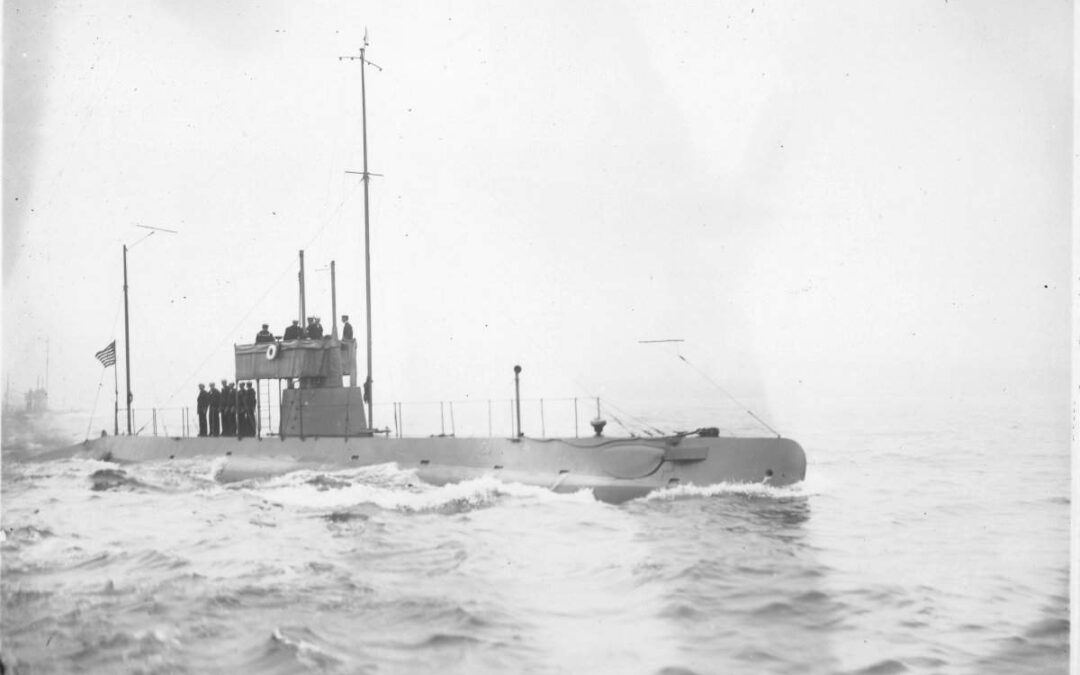
Britain’s naval relationship with the United States during the First World War was surprisingly complex. On the one hand the US began constructing naval forces of scale to rival Britain’s, a process that gained diplomatic import and has been referred to by historians as the ‘struggle for Neptune’s trident’.[1] But on the other hand the two nations also enjoyed a close and collegial naval association in which they freely exchanged ideas, technologies and even details of ship designs. The November 1917 appointment of the British naval architect Stanley Goodall as Naval Attache in Washington, tasked with liaising closely with the Bureau of Construction and Repair, is perhaps the best known of the connections.
Less well known is the scientific mission that the British and French jointly sent to the United States in mid-1917, which kick-started the US Navy’s development of underwater submarine detection. This was a major issue for the Allies by this stage of the war. Work to develop suitable systems had been under way in Britain and France since 1915, but was given impetus from January 1917 after the German decision to recommence ‘unrestricted’ submarine warfare, in which U-boats simply attacked merchants on sight instead of stopping and searching them. The German decision to do so was one of the factors that finally drove the United States towards the Allies. In March 1917 the Secretary of the Navy, Josephus Daniels, ordered Vice-Admiral William S. Sims to open an office in London as the official United States Naval Representative, initially to discuss how best the US Navy could support the British. War had yet to break out between Germany and the United States, but it was clearly looming – and on 6 April, Congress voted to do so.
Sims arrived just as the U-boat emergency reached its peak. The German decision to resume unrestricted submarine warfare at the end of January 1917 provoked alarm in Britain. Merchant losses soared, threatening survival: the nation relied on imported food and by April 1917 estimates indicated that just three to ten weeks worth remained in country. Sims reported to Washington that it was perhaps the ‘sharpest crisis’ to date.[2] Later he refuted suggestions that US forces had materially helped Britain during the moment, telling media that the British were deploying around 3,000 anti-submarine craft and minesweepers of all scales, where the US contribution was ‘only about 160’.[3] This was understandable: in 1917 the US war effort was only just beginning. Just as crucially, the British were also close to finalising a system for detecting submarines underwater, something the United States had only just begin investigating.
As we saw in an earlier article, this system was developed by the Board of Invention and Research (BIR), a Royal Navy organisation led by Admiral Sir John Fisher with the aim of using Britain’s most eminent scientists to produce new naval technologies. Top of the list was a system for locating submarines underwater, which relied on both passive listening by underwater microphones (‘hydrophones’) and an active ultrasonic broadcast system which, again, was picked up by underwater microphones. The latter became known as ASDIC, a cover name created by adding ‘ic’ to the name of the Royal Navy’s Anti-Submarine Division.
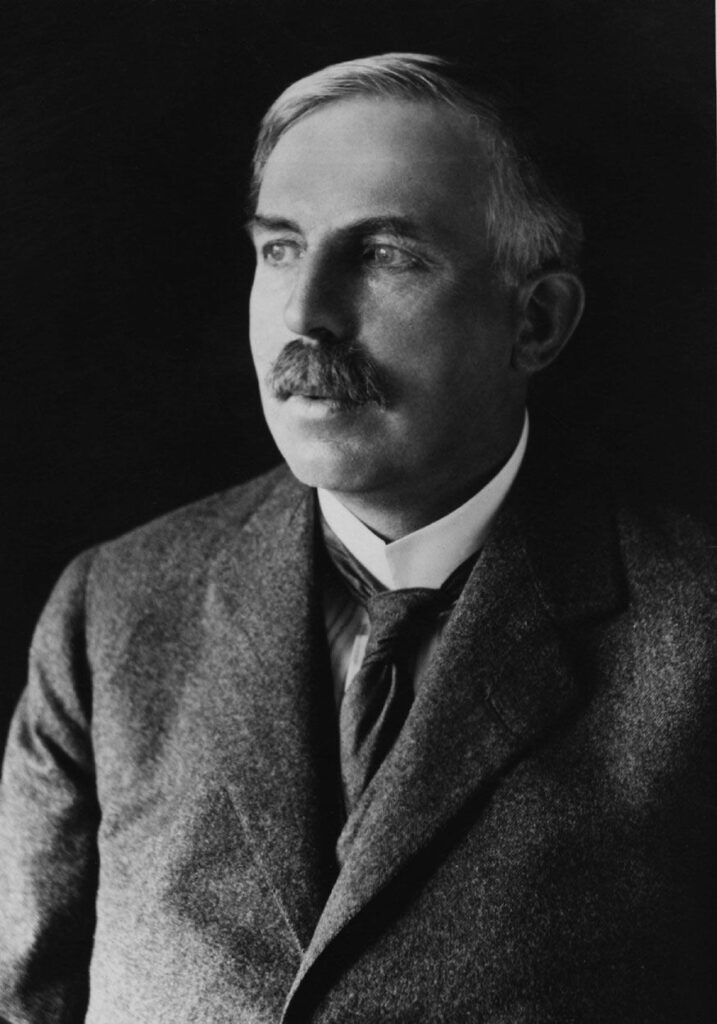
The physicist behind the underwater microphones was Sir Ernest Rutherford, the man who had identified what radioactivity actually was, who had discovered the atomic nucleus – and with that, re-set the entire basis by which chemistry was understood – and who by 1914 was working on ways to split an atomic nucleus in order to discover more about its composition.
The work of the BIR on underwater sound detection was paralleled by a similar push in France, led by the physicist Paul Langevin – also a long-standing friend of Rutherford’s – and there was a good deal of interchange. Langevin apparently pointed Rutherford to piezoelectric detection, which was based on a device built in 1882 by Pierre Curie. Rutherford began experimenting with quartz as a means of generating high-frequency sound underwater, using it for echo experiments in his laboratory water tank. His focus remained an underwater microphone, and he worked closely with his friend and colleague William Bragg, another leading physicist. Between them they developed and patented an underwater listening system. Both this and Rutherford’s quartz sound generator then became key elements of an active search system being developed at the same time in the Admiralty Research Laboratory by Canadian physicists Robert Boyle and Albert Wood. They were not strangers to Rutherford: indeed, Boyle had been a colleague of Rutherford’s at Manchester University.
By 1917 Boyle and Wood had produced a working prototype of their ASDIC system, incorporating Rutherford’s piezoelectric transmitter and detector. The British were still some way off being able to put a working system to sea – in fact the first experimental seaborne ASDIC unit was not deployed until late 1918, aboard the 613-ton patrol boat HMS P-59. However, the US entry into the war brought with it a need to brief the US Navy on European anti-submarine technology as it stood in early 1917. The groundwork for broad-reaching liaison at multiple levels was laid by the so-called Balfour Mission to Washington, which set out a programme for comprehensive and ongoing collaboration between Britain and the United States. In May Rutherford was asked to join a combined Franco-British naval-scientific delegation, broadly to brief US Navy experts and leading scientists on the new hydrophones and ASDIC systems among other technologies.
Rutherford wasn’t sure he wanted to go. He was pressed for time, largely because to him the top priority was not submarine detection, but finding out how to split the atomic nucleus. There is circumstantial evidence that this wasn’t just due to his relentless scientific curiosity. He knew that the partial breakdown associated with radioactivity released colossal energies – the energy emitted by radium, for example, dwarfed what was possible with ordinary chemical reactions. The nucleus clearly contained even more energy and there is circumstantial evidence that he was worried somebody might find a way of weaponising it. He had, indeed, been quizzed about ‘atomic bombs’ by the media soon after outbreak of war in 1914. He publicly dismissed the idea: it lay outside known physics just then – but he was well aware that much remained to be learned, and his own team had already found hints that a new particle lay within the nucleus. Investigating this issue was high on his agenda in 1915 when war dispersed his research team. He had only been able to get to this work since in fits and starts, working solo during his spare time while most of his time went to the BIR, and it frustrated him.
Now Rutherford was being asked to go the United States, and to him it looked like a junket that would only waste his time. He asked his colleague J. J. Thomson, who was also a member of the BIR. Was this mission ‘worth undertaking’ and not simply a gesture ‘of a complementary nature’? [4] Thomson felt it might be useful, so Rutherford decided he should go. He wrote to his mother, back in New Zealand, telling her on 15 May that ‘you will be surprised to hear I am leaving in a few days for the U.S.A., via Paris.’[5] He worried about the dangers and updated his will before he left.
The British side of the delegation consisted of Rutherford and a Royal Navy representative, Commander Cyprian D.C. Bridge (1885–1939). They initially went to Paris, where Rutherford gave a lecture to his French counterparts and had lunch with his old friends Langevin, Marie Curie and André-Louis Debierne, who ‘treated me in royal fashion’. Rutherford had not seen his colleagues for some years and found Curie ‘grey and worn and tired’.[6] The mission left for the United States from Bordeaux, with the French delegates, Henri Abraham of the University of Paris, Charles Fabry of Marseilles University – the man who discovered the ozone layer – and three officers, Captain de Grammant, Captain Dupoing and Lieutenant Peterno.
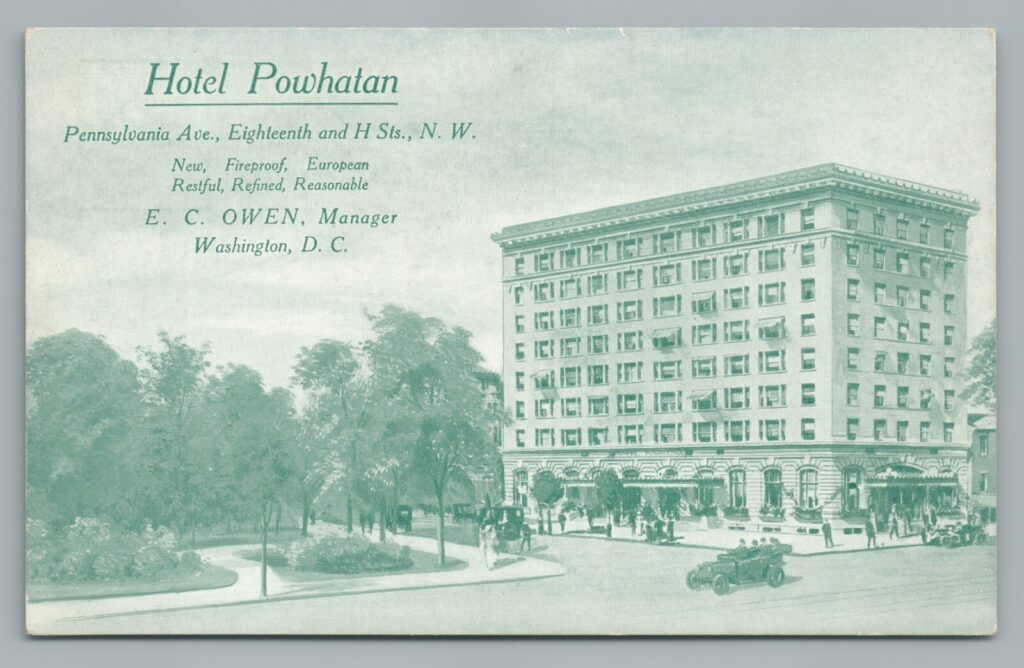
Despite Rutherford’s unease about running the U-boat gauntlet they crossed the Atlantic without incident. The first evening in New York took the Franco-British delegation to a dinner party where, as Rutherford wrote later to his wife, they ‘met a number of scientific men engaged in submarine question’. They then went on to Washington where it turned out accommodation was hard to get: they ended up in the Hotel Powhatan and were met by Rutherford’s friend Ellery Hale – the astronomer – Robert Millikan and others. Millikan was there in active support of the naval mission. By 1 June the meetings were under way in earnest – a significant schedule with multiple committees that took much of the day. They also met Newton Baker, the US Secretary for War, and Josephus Daniels, the Secretary of the Navy. Three days of meetings followed with representatives of the Naval Advisory Board and the US Navy’s Research Council, which Rutherford felt were ‘highly successful’.[7]
In and around these meetings Rutherford was able to catch up again with Hale and escape briefly with Bridge to see Gettysburg. He visited friends at Yale, where he was awarded an honorary Doctor of Science. Rutherford stayed long enough to join the award ceremony, walking in line with former US President William Taft. The heat got to him, although it was only early summer. On 12 June the mission went to Boston to ‘see some experiments’, and on the 23rd they visited the submarine base at New London.
The mission worked to a packed schedule. Finally Rutherford had two days off and was able to whip north to Canada and spend two days in Montreal, where he visited his old haunts at McGill University and contacted old friends, before returning to New York for the journey back to Britain. ‘I have had a very busy time,’ he wrote to his mother on 29 June, ‘discussing and explaining the submarine situation to a number of naval and scientific men. We came at the psychological moment as they had already begun work but were very uncertasin what had been done in The liner was crowded with a US Marine unit whose mascot, a goat, decided to use Rutherford’s cabin for its own.[8]
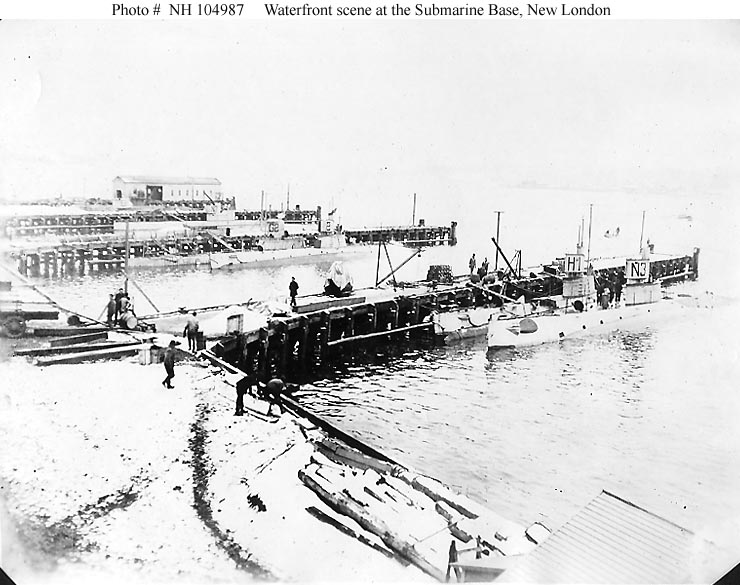
The mission had a significant impact. Up to that time the US Navy’s primary civilian science advisor was the ageing inventor Thomas Edison, who had essentially excluded the academic physics community. But after the Franco-British mission, the US Navy’s Research Council produced a report recommending an experimental station should be set up at the New London submarine base, with staff including ten top scientists who could work on the British detection systems.[9] One of the US scientists, Irving Langmuir, later told Rutherford that the Franco-British mission’s visit had ‘started our work on the submarine problem in the right direction’ and had ‘guided us throughout.’[10] It was a significant achievement, making it all the more surprising that this mission has remained little known to history.
Matthew Wright is a professional historian and a Fellow of the Royal Historical Society at University College, London. For more on Rutherford and modern physics buy his book Ernest Rutherford and the birth of modern physics (Scribe, New York, 2025), available from any good bookstore or online.
Copyright © Matthew Wright 2026
Further work for Matthew Wright may be found at his website.
[1] Chapter title in Michael Simpson (ed), Anglo-American Naval Relatons, 1917-1919, Navy Records Society, 1991.
[2] Ibid, p. 191.
[3] Caltech Archives & Special Collections, George Ellery Hale papers, Box 38, Folder 12, Admiral William S. Sims, typescript, ‘Memorandum: remarks by Vice-Admiral Sims at luncheon given by Lord Beaverbrooke Minister of Information, to visiting American editors, September 6th, 1918’.
[4] Cambridge University Library (CUL) RP Add 7654, Rutherford Correspondence R, Rutherford to ‘Professor’ [Thomson], 4 May 1917.
[5] CUL RP Add 7653, Misc. files and notes, PA306, Newspaper cuttings and letters of E.R. to Mother (published by Jim R.), Rutherford to his mother, 15 May 1917.
[6] Rutherford to Mary Rutherford, 18 May 1917, quoted in Arthur Eve, Rutherford, Cambridge University Press, Cambridge 1939, p. 257. This was Rutherford’s only authorised biography.
[7] CUL RP Add 7654, Correspondence R, Rutherford to ‘Professor’ [Thomson], 4 June 1917.
[8] Eve, p. 262
[9] Noted in Eve p. 256.
[10] CUL RP Add 7653, Rutherford Correspondence L1-75, Langmuir to Rutherford, 18 May 1919.

Recent Comments