
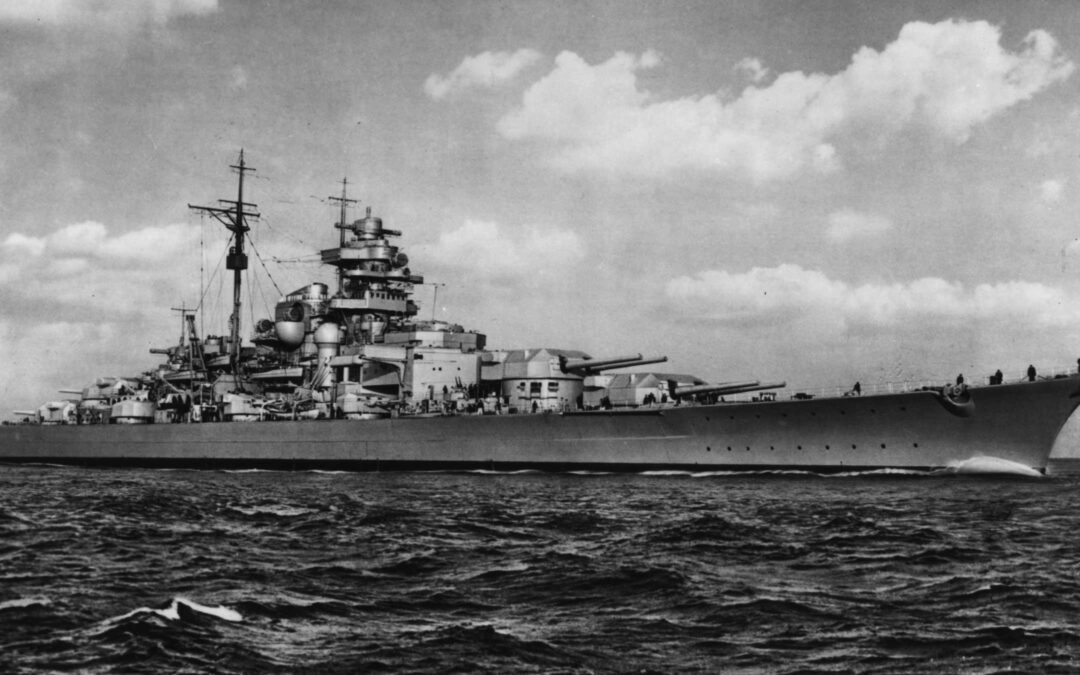
The events surrounding the brief Atlantic sortie of the German battleship Bismarck in May 1941, have been told many times. Analysis often focuses on engineering and combat performance,[1] or on the tactical issues associated with finding a lone warship in the North Atlantic. It is often seen in isolation – an ‘episode’, according to Russell Grenfell’s semi-official 1948 book on the subject.[2]
These approaches draw historical attention away from the strategic reality, which was that this dramatic 200-plus hour pursuit was far more important to Britain than a single ship sortie should have been. The point was made clear when the Prime Minister, Winston Churchill, demanded that the Home Fleet’s only undamaged modern battleship, HMS King George V, stay in pursuit even if it ran out of fuel and had to be towed. He had the First Sea Lord, Admiral Sir Dudley Pound, send this absurd demand to Home Fleet commander Admiral Sir John Tovey on 26 May.[3] It was classic Churchillian hyperbole: he knew very well that neither Tovey, nor King George V’s commander, Captain W. R. Patterson, would ever put the battleship in that position. But the demand made the stakes clear.
In a historical sense this seems curious: Bismarck was one ship in a struggle between two of the world’s major nation-states, deploying tens of thousands of men, aircraft, ships, and backing all with national-scale economic and industrial power. At this level the fortunes of a single vessel surely meant little to either side. What was going on? The explanation rests in Britain’s strategic position of the day. One immediate issue was the fact that Bismarck sortied amidst the collapse of the Balkan campaign – which, as Churchill pointed out, rendered that sortie an event of ‘the highest consequence’.[4]
But this was only an immediate issue: Britain faced other and much deeper problems, all of which were coming to a head by early 1941. The fall of France meant that the whole weight of blockading the Mediterranean – and of supporting the forces keeping Britain’s Middle Eastern oil supplies safe – fell on the Royal Navy. The Italian fleet included modern fast battleships. Meanwhile, Germany posed a significant surface threat in the Atlantic. The German fleet was small but modern and at outbreak of war included two fast battleships. While – as William Garzke and Robert Dulin have noted – the two Schlachtschiffe (battleships) Scharnhorst and Gniesenau were given 11-inch guns largely for political reasons,[5] they required fast battleships to counter them. This threat intensified: by early 1941 Germany’s two full-scale modern battleships Bismarck and Tirpitz were completed and working up. Britain needed to deploy a materially superior force to counter these, meaning their own new fast battleships: but in early 1941 just two were available. A third, Duke of York, was not expected to be fully ready for service until year’s end.[6] The last two were expected to follow later in 1942. Until then the only heavy British ships able to match the speed of the new German vessels were three older battlecruisers. Of those, Renown and Repulse were under-armoured, leaving only Hood to support the new fast battleships.
The practical reality, in short, was that in early 1941 Britain was scrabbling to deploy enough fast heavy ships, an issue that ultimately threatened the ability to both maintain blockade and to protect Britain’s own essential sea lanes. This was serious. As Richard Overy has shown, by the mid-1930s democracy was but one of three major world governmental systems. The other two – fascism and communism – were in the ascendant. Overy has argued that as late as 1942-43 there was no guarantee that democracy would prevail.[7] Prospects certainly seemed dark in May 1941, when the British Empire fought essentially alone.
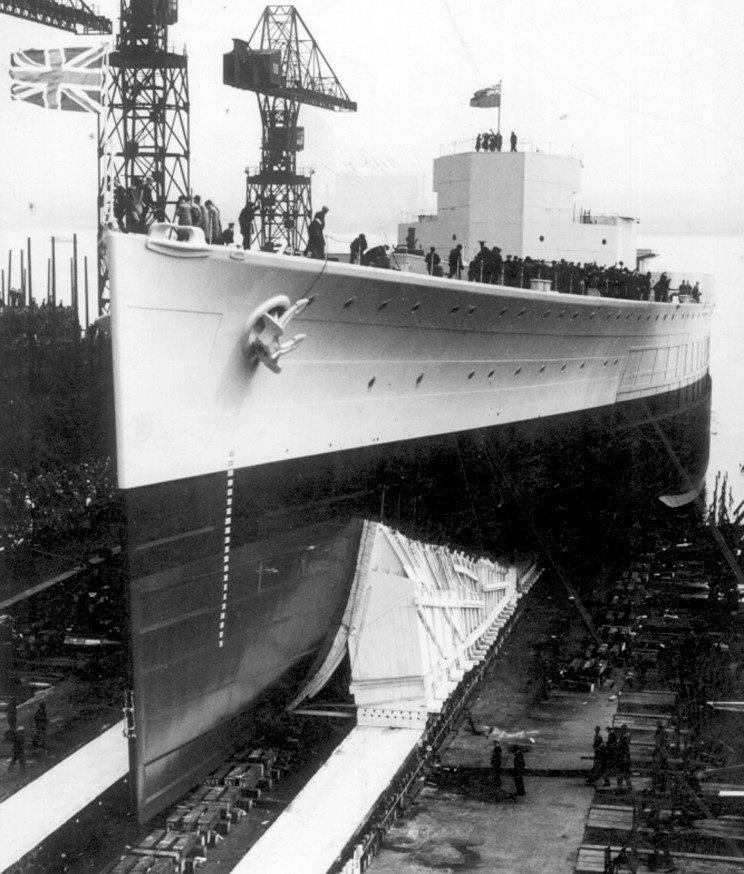
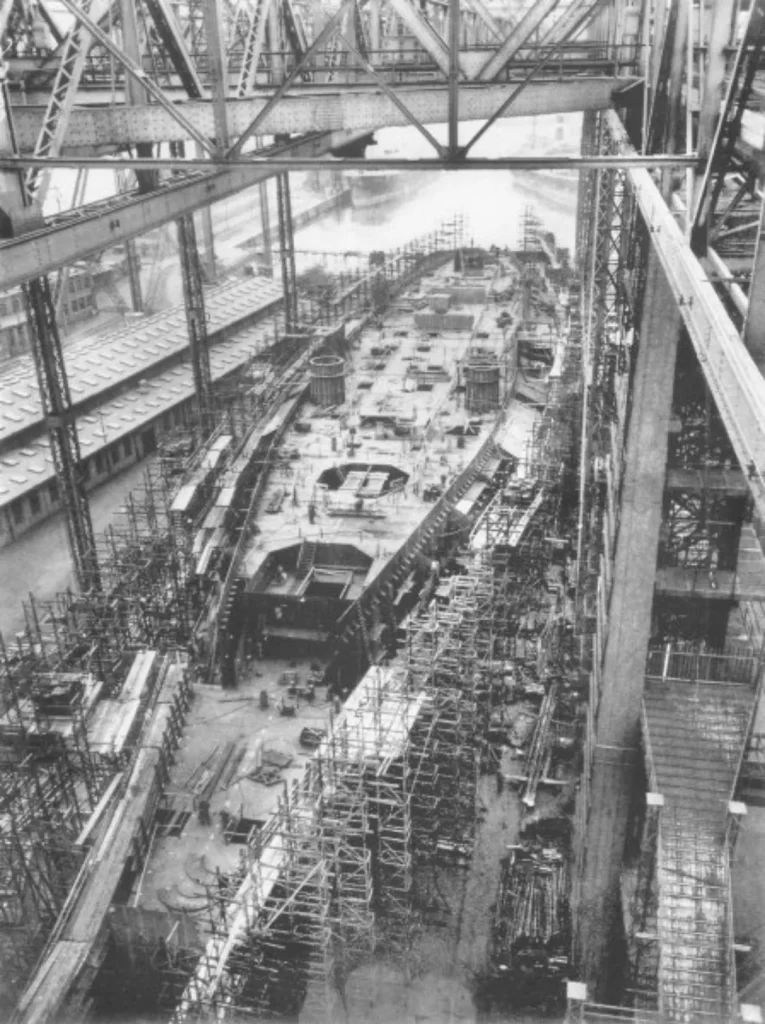
Part of Britain’s challenge at this point can be traced to the unexpected fall of France. However, the ultimate cause can be traced to Britain’s inter-war decline and under-funded effort to remobilise. The details have been subject to academic debate,[8] but the main problems are clear. The naval construction industry consolidated sharply from 1927 and defence spending remained low until the mid-1930s. Overall British defence spending rose from 2.2 to 6.9 percent of GDP during the late 1930s, however GDP per capita was only just climbing above First World War levels, and the programme announced by Stanley Baldwin at the end of 1935 was debt-funded. This last issue drew the attention of the Treasury, which throttled the rate of spending. As a result, while Britain’s total defence budget stood at £42.6 million in 1935, the full-scale rearmament programme the following year only produced a modest rise to £60.7 million. Increases remained modest until 1938 when the German union with Austria prompted fresh alarm.
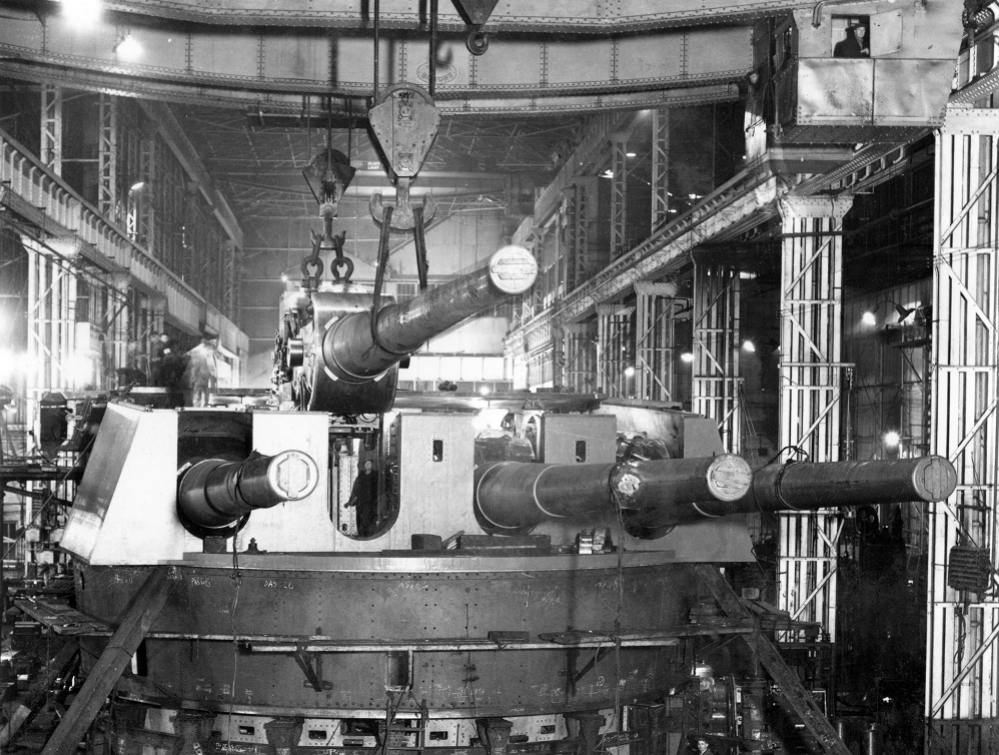
The naval problem was that this funding was split unevenly. In 1934 the Defence Requirements Sub-Committee of the Committee of Imperial Defence called for a ‘two power standard’ by 1942, including 20 capital ships and 15 aircraft carriers,[9] but Cabinet repeatedly knocked back Admiralty efforts to prioritise naval building programmes. The naval share of the defence spend dropped from 56.8 percent in 1935 to 30.35 percent in 1939.[10] Practical bottlenecks included constraints on capacity to build naval fire-control equipment, armour plate and capacity to build gun-mountings.[11] Another problem was a shortage of trained draftsmen to create construction drawings. The practical outcome was that the Royal Navy embarked on what was called an ‘accelerated’ building programme in 1936, but in 1938 – even as absolute budgets rose – the original scheme was replaced by what was called a ‘rationed’ programme.[12] This was expected to be complete by 1946.
The limits of industry and labour resource meant that this could not change quickly even after war broke out in 1939 – indeed, one immediate outcome was a temporary hold on the three part-built King George V class battleships of the 1937 programme. Even when construction resumed, resources had to be balanced against an expanded and very urgent light-ship programme. By the beginning of 1941 just one modern battleship, HMS King George V, was available. It is a sign of need that the second, Prince of Wales, was hastily repaired after receiving bomb damage while fitting out, and commissioned on 19 January. This usually marked the start of a lengthy final commissioning sequence, but she was deemed complete just six weeks later by short-cutting the processes.[13] In practise this meant that when she sailed to face Bismarck in May she had yet to fully work up and still had dockyard workers aboard.
The fall of France in mid-1940 threw a wrench into the calculation. This knocked out the French fleet, throwing the whole weight of the Mediterranean blockade on to the Royal Navy, and simultaneously gave Germany access to naval bases on the Atlantic coast. The cruiser Admiral Hipper arrived in Brest at the end of December 1940 after an Atlantic raiding cruise. The nightmare scenario of fast German capital ships operating in the Atlantic finally came true in January 1941, when Scharnhorst and Gniesenau broke out and began raiding British convoys sailing from Halifax. This highlighted the challenge. The Home Fleet under Admiral Sir John Tovey had both Nelson-class battleships to hand, but he had just one fast capital ship under command that could match their speed, the battlecruiser Repulse. The situation was complicated by the fact that Hipper left Brest on 1 February, and the armoured ship Admiral Scheer was already at large.
What this meant in practise was that the British had to use their older battleships as convoy escorts, further stretching the Royal Navy. Tovey then had problems finding the two German battleships, highlighting the challenges of locating warships in the Atlantic. The effort extended to using Force H, based at Gibraltar and primarily intended to close the Mediterranean to the Axis. In the end the German force reached Brest after sinking or capturing 22 ships. It would likely have achieved more had Admiral Lutjens not been hampered by orders to avoid engagement with heavy British ships, which prevented their engaging a convoy screened by the old battleship HMS Ramillies. The Royal Air Force began targeting the German vessels in Brest, but their presence on the Atlantic coast meant the Royal Navy had to maintain sufficient forces to counter a further sortie.
The other major focus of early 1941 was the Mediterranean, where the British expected Germany to launch a major offensive designed to take the Middle East and cut of British oil. Churchill had commissioned a paper on the matter from his friend Major-General Bernard Freyberg in 1940, and the War Office was of the ame sopinion. The arbiter remained sea power, and Italy’s Regia Marina was a significant force.[14] Admiral Andrew Cunningham’s Mediterranean Fleet was built around Queen Elizabeth class battleships dating to 1915-16. Two were modernised, but they were at a disadvantage against new designs. This did not prevent Cunningham taking the war to the Italians: he was, arguably, Britain’s greatest fighting Admiral since Nelson, using his forces with a verve that did much to offset their paper inferiority. But then in March 1941 the decision was taken to support the Greeks in their war against Italy on the ground, meaning Cunningham’s forces had to operate under conditions of enemy air superiority. By mid-May the Mediterranean Fleet had suffered significant light-ship losses through damage and to sinking.
Britain’s strategic position was on a knife-edge by this time. The risk of direct invasion had receded by early 1941, but Germany dominated Europe on land and the risk of a German thrust through North Africa into Britain’s middle-eastern oil supplies seemed high. Indeed, that is exactly what German High Command proposed. Worse, the fall of the Netherlands and France produced a power vacuum in their colonies of the Far East. Here, Japan had been prosecuting a war against China and were determined to stop the Chinese importing arms through French Indo-China. Japan’s invasion of the former French possession in September 1940 raised tensions with the US and Britain. The British had strategic responsibility for the security of its two Dominions, Australia and New Zealand, who had long viewed Japan as a major threat. The advent of the Tripartite Pact in late 1940 drew Japan directly into the Axis sphere, raising the stakes.
The Royal Navy did not have the power to confront the threat in all areas. Certainly the ‘main fleet to Singapore’ strategy, designed to counter war with Japan, could not be implemented while war raged in Europe. Any help was welcomed: when the United States requested access to British naval facilities at Singapore in October 1940, if needed, the British were happy to grant it.[15] By 1941 tensions in the Pacific were rising, but at a Defence Committee discussion of 19 May the Admiralty made clear that until the United States entered the war and stationed ships in the Atlantic, the Royal Navy had nothing to send to the Pacific without stripping other fleets.[16]
This came just as the Balkan campaign was collapsing, and when Bismarck and Tirpitz were known to be readying for operations. The Atlantic was one of Britain’s crucial theatres of the day. The primary load fell on the Royal Navy, particularly because of the ‘mid-Atlantic gap’ where land-based air power lacked the range to operate. A construction programme designed to produce escorts was gaining pace by 1941, but merchant losses mounted and in December 1940 the British decided to discontinue supplying Ireland, turning the tonnage so released to their own imports.[17]
This was the context in which Bismarck sortied with the cruiser Prinz Eugen. Given the strategic position, the loss of Hood during the attempt to intercept this force off the Denmark Strait was significant, and the 72 hours after the loss of Hood on 24 May were dark hours indeed for the Royal Navy. While we know what happened, the British did not know their future. On 26 May, as the crisis in the Atlantic reached its peak, the Mediterranean Fleet – though down to its last few undamaged cruisers and destroyers – was called on to evacuate British, Australian and New Zealand forces from Crete. This was expected to produce losses, leaving an exhausted and damaged fleet that could not engage in further operations for some time.
The collapse of the Balkan campaign was yet another setback in a war filled with setbacks for Britain, ranging from the unexpected fall of France to rising tensions in the Far East, all given power by the effective failure of pre-war rearmament efforts. In this circumstance a nightmare scenario in which Bismarck, Scharnhorst and Gniesenau were available for Atlantic operations – perhaps supported by Tirpitz – became a major risk. To this had to be added what Churchill later called the ‘moral effect’.[18] Some kind of victory amidst the constant flow of bad news had become essential by May 1941, both to show the United States that Britain was not a lost cause and to boost morale among the British public.
In that circumstance Britain had only one strategic priority after the loss of Hood: Bismarck had to be sunk before reaching port – justifying the way the British then deployed Force H from Gibraltar and stripped their convoy escorts, irrespective of the cost of risk to the forces so exposed. The point underscored the fact that the stakes were strategic, transcending the fact that Bismarck was but one warship in a world of total war between major nations.
Matthew Wright is a professional historian and a Fellow of the Royal Historical Society at University College, London. Buy his book Battleships by Constraint: the forces shaping Britain’s last generation of capital ships at: https://www.amazon.com/Battleships-Constraint-shaping-Britains-generation/dp/0908318324/
Copyright © Matthew Wright 2025
[1] For a useful online resource of this kind see William H. Garzke and Robert O. Dulin, ‘Bismarck’s final battle’, http://www.navweaps.com/index_inro/INRO_Bismarck.php
[2] Russell Grenfell, The Bismarck Episode, Macmillan, New York, 1948. Grenfell had Admiralty support and access to documents otherwise on the secret list, along with input from Admiral of the Fleet Lord Tovey.
[3] Winston Churchill, The History of the Second World War, Vol.. III, The Grand Alliance, Cassell & Co, London 1950. p. 282.
[4] Churchill, p. 270.
[5] Willam H. Garzke and Robert O. Dulin, Battleships: Axis and Neutral Battleships in World War II, Jane’s Publishing Company, London 1986, p. 131. Note that the official German term for these ships was ‘battleship’.
[6] She commissioned on 4 November but although then despatched to take Churchill across the Atlantic to meet US President Roosevelt, was not fully worked up until early 1942.
[7] Richard Overy, Why the Allies Won, Second Edition, Pimlico, London 2006, pp. 18-22.
[8] See, e.g. George C. Peden, ‘The Royal Navy and Grand Strategy 1937-1941’, in N. A. M. Rodger, J. Ross Dancy, Benjamin Darnell and Evan Wilson (eds), Strategy and the Sea: essays in honour of John B. Hattendorf, The Boydell Press, Woodbridge, 2016, pp. 148-158.
[9] Postan, p. 25.
[10] Author calculation from figures given in Michael Postan, British War Production, HMSO, London 1952, p. 12.
[11] Noted in Peden, p. 157.
[12] Postan, p. 469.
[13] William Garzke and Robert O. Dulin, British, Soviet, French and Dutch Battleships of World War II, Jane’s Publishing Company, London 1980, p. 177.
[14] See, e.g. order of battle in https://comandosupremo.com/regia-marina-oob-1940/ accessed 10 June 2025.
[15] J. R. M. Butler, Grand Strategy Volume 2, September 1939-June 1941, H. M. Stationery Office, London 1957, p. 488.
[16] Ibid, p. 502-503.
[17] Winston Churchill, The Second World War, Vol. II, Their Finest Hour, Cassell & Co, London 1949, p. 530.
[18] Winston Churchill, The History of the Second World War, Vol.. III, The Grand Alliance, p. 286.

Recent Comments