
“For my part, I consider that it will be found much better by all parties to leave the past to history, especially as I propose to write that history myself.” – Winston Churchill in speech to the House of Commons, 23 January 1948.[1]
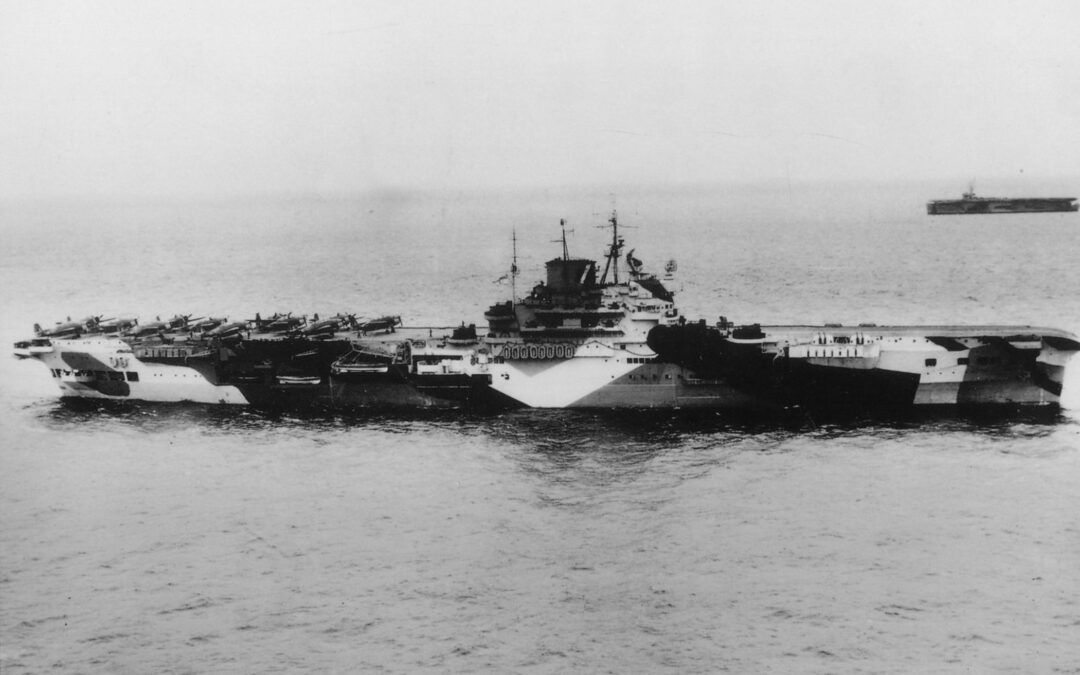
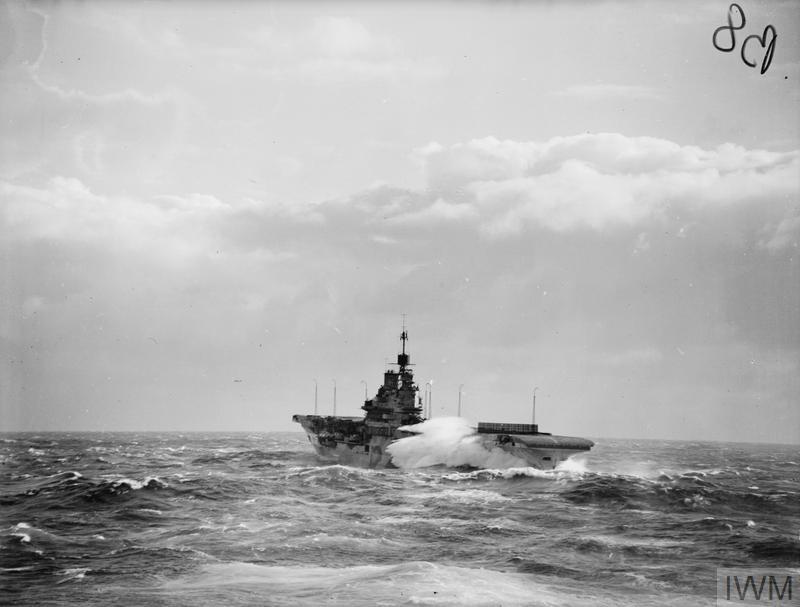
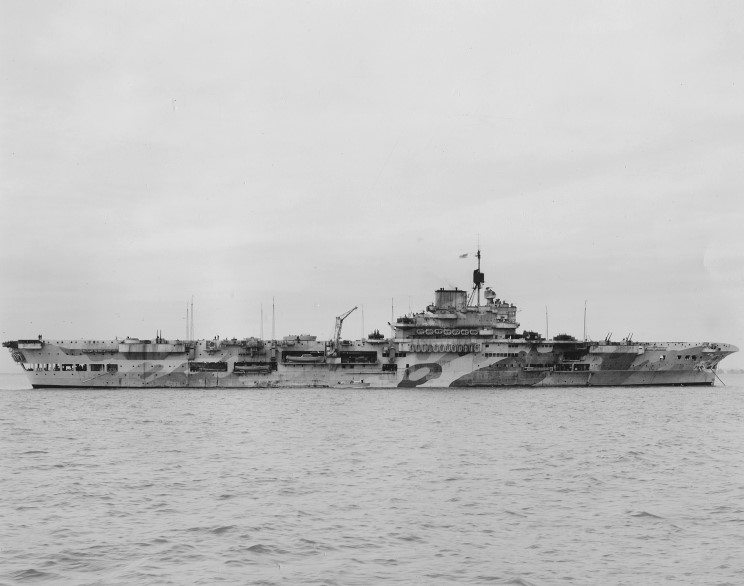
In October 1941 Britain’s new armoured carrier HMS Indomitable sailed to the Caribbean for a three-week work-up. This had barely begun when, on Sunday 2 November, she ran aground while entering Kingston Harbour and required docking for repair. The work was arranged at the US Navy’s dockyard in Norfolk, Virginia – job number S.139 – and by 5 November, United States Navy authorities confirmed the air wing could be landed at Norfolk to continue training.[2] The carrier did not return to Jamaica until the 24th.[3] One long-standing assertion is that this delay for repairs stopped her deployment to the Far East with the Prince of Wales and Repulse.[4] They were lost on 10 December to air attack in the South China Sea, prompting a good deal of criticism to the effect that they had been sent too far forward without air cover. The narrative that Indomitable was prevented from joining thanks to grounding has been repeated ever since in secondary works and social media alike.[5]
There is only one problem. As we shall explore in this article, Admiralty documents show this story to be a myth. Even when war with Japan broke out, the Admiralty had a very different destination in mind for the carrier. The real question is how this mythology could become so embedded that it was accepted for decades?
The story first came to wide public readership in the third volume of Winston Churchill’s History of the Second World War, published in 1950. Here he declared, directly and without ambiguity, that a carrier was essential and Indomitable would have gone with the two capital ships had she not grounded.[6] This appeared on the face of it to be a simple statement of fact, and Richard Hough’s classic The Hunting of Force Z is an example of how that narrative then flowed into the secondary literature.[7]
Oddly, the official histories told a subtly different tale. The earliest official publication was Battle Summary 14 by the Historical Section of the Admiralty, issued as a restricted document in 1943. This was then ordered destroyed.[8] The second version was completed in June 1954 and published the following March, and while this was in response to information provided from Japanese sources, the revision included ‘various minor amendments’.[9] The Indomitable appears in just one line: ‘It had originally been intended to include an aircraft carrier in the squadron, but owing to the recent grounding of the Indomitable none was available’.[10] There is no direct statement that Indomitable was tipped to go, but the implication is clear, a vagueness that contrasts with the precision of the rest of a document intended as both official record and training resource.
Plans for Indomitable were just as ambiguously described in the first volume of Stephen Roskill’s official history of the RN during the Second World War, published in May 1954. Here he made one reference to Indomitable being ‘earmarked’ to go to the Far East.[11] But that was all. He then mentioned Indomitable’s grounding off Kingston in context of the loss of Ark Royal off Gibraltar and the lack of carriers in the Mediterranean. And a list he published of British forces scheduled to assemble in the Far East did not include her.[12] This was uncharacteristic. Roskill was a stickler for detail – a habit he had shown during war service when, while XO aboard HMS/HMNZS Leander, he gained the nickname ‘the Black Mamba’ as a result of his demand that the crew were as knowledgeable as he was about ship systems.[13]
The narrative, however, did not change until the turn of the twenty-first century.[14] Arthur Nicholson cast doubt on the Indomitable story in a 2005 book, showing that the carrier was never ordered to join Prince of Wales and Repulse. Even if she had been ordered to go, and not grounded off Kingston harbour, the timing of her work-up in the Caribbean meant she could not have joined them by early December.[15] Andrew Boyd took that a step further, presenting his conclusions in a doctoral thesis of 2015, followed by a book.[16] Boyd showed that none of the Admiralty planning material referred to Indomitable being ordered to join the two capital ships, and that when Admiral Phillips met US Admiral Thomas Hart on 6 December he made no mention of a carrier due to join his force at Singapore.[17] That matched Roskill’s account.[18] Boyd also noted that the First Lord of the Admiralty, A. V. Alexander, gave a speech to the House of Commons in secret session on 19 December and stated that no carrier was available.[19] This alone busted the myth, but Boyd also found proof that the Admiralty had different plans for Indomitable. A minute penned at the end of September 1941 by the Director of Plans, Captain E. Gerald Bellars, indicated that once worked up she would replace Ark Royal at Gibraltar, releasing the latter for a long overdue refit.[20]
As it happens, proofs are not limited to the documents Boyd cited. Other Admiralty documents, which I researched for this article, show that the Gibraltar plan for Indomitable remained in place well after debates over sending a modern battleship east played out. Prince of Wales was ordered to Singapore on 11 November.[21] However, a proposed programme for Indomitable issued on 21 November put the carrier in Kingston until 8 December, when she was due to sail for Gibraltar with arrival there estimated at 16 December.[22] That destination remained unchanged as late as 4 December when Vice-Admiral Sir Charles Kennedy-Purvis, Commander in Chief of the America and West Indies Station, suggested Indomitable should call in to Trinidad for training with RNAS Piarco ‘before sailing for Gibraltar’, and ‘if working up and subsequent program permits.’[23] The Admiralty concurred in a brief message sent three days later, Sunday 7 December, the same day they signalled the outbreak of war with Japan.[24]
The fact that Indomitable was due to join Force H at Gibraltar after her Caribbean work-up fits with Roskill’s association of Indomitable with Ark Royal and the Mediterranean.[25] Furthermore, a briefing note Boyd found attached to Alexander’s secret session speech notes indicated that Ark Royal had been expected to join the Far Eastern fleet in early 1942 after refit.[26] This matches remarks in Battle Summary 14 referring to the Admiralty’s March 1942 target for assembling its eastern forces being driven by ‘necessary refits’.[27] This was overthrown by Ark Royal’s loss on 14 November, but that did not alter the decision to send Indomitable to Gibraltar.
So where did the Indomitable-goes-east narrative come from? Churchill certainly wanted a carrier with the force being sent east, urging such in a meeting on 17 October.[28] But he got no traction. This was not due to lack of understanding in the Admiralty: by 1941 the administration accepted that naval forces required air support, and included a carrier in their plan for the Far Eastern fleet. But war had yet to break out in the Pacific, and intelligence suggested Japan would not be ready to fight before early 1942. Meanwhile there was war in Europe. In such circumstance, sending a carrier to Singapore early for diplomatic purposes was not so crucial. Indeed, the two capital ships were despatched amid concerns that sending too strong a force early would have been provocative.[29] In short, based on what was known in October-November 1941, the Admiralty plan to send Indomitable to Gibraltar was reasonable in ways that sending her east was not.
Events, of course, overtook that scenario – and with dramatic speed. Reasons why the ships lacked air cover, generally, framed the terms of reference for a preliminary enquiry launched by the Admiralty within a day of the sinkings. The specific lack of a carrier was raised in the House of Commons on 16 December by Sir Archibald Southby, who wanted to know whether ‘responsible naval staff’ had recommended the capital ships be joined by a carrier and, ‘if so, who over-rode their expert advice?’ Churchill was not present at the time and the Lord Privy Seal, Clement Attlee, deferred answers.[30] In short, the lack of a carrier became a political hot-point, given teeth by outcome bias. Southby did not let it go: when the preliminary enquiry reported back in January he asked the First Lord, A. V. Alexander, whether any full enquiry would ‘establish the responsibility for these ships being sent to the East without aircraft protection?’[31] Southby was far from alone: in April 1942 Lord Maurice Hankey called for an enquiry into air support with terms that included investigating the decision-making process in London.[32]
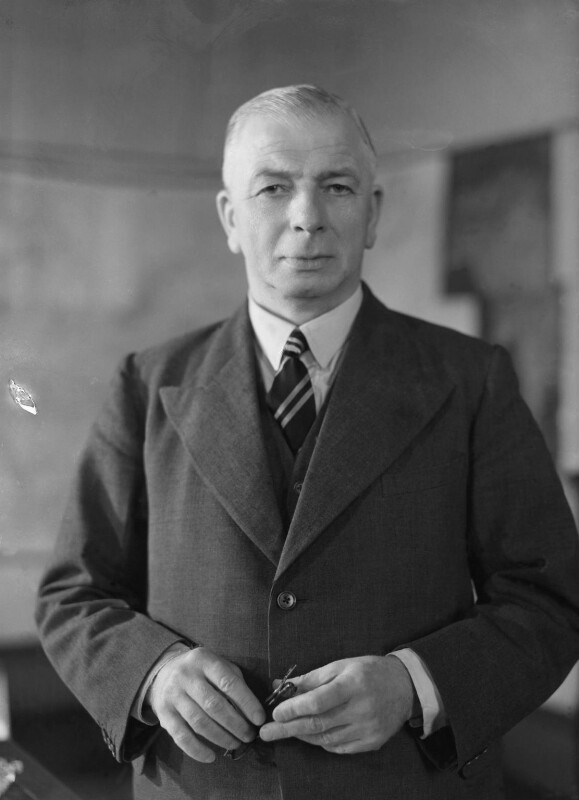
In this circumstance it was understandable that key players – primarily Churchill – would want to deflect critique. As we have seen, that gained particular form in 1950, in the third volume of Winston Churchill’s History of the Second World War. According to Churchill an ‘essential element’ of the force being sent east in November was Indomitable, but she was ‘temporarily disabled by an accident’. As a result, Churchill continued, ‘it was decided in spite of this to let the two fast capital ships go forward’.[33] These words are remarkable for their economy with the truth. A carrier is what Churchill wanted, and he pressed for one in a meeting of 17 October 1941.[34] But he did not get it then, or in a meeting of 20 November, when the decision was taken to send a modern battleship as far as Capetown.
Is there any truth at all in Churchill’s published assertion? It is possible that Indomitable was discussed during 8-11 November, when the Admiralty made the final decision to send Prince of Wales to Singapore.[35] This post-dated Indomitable’s grounding, and informal chats may have played out as Churchill’s words imply. But such speculation has to be set against the fact that a fortnight later he told the Admiralty he did not want a modern carrier sent around the Cape until the Mediterranean situation was clear.[36] Furthermore, signal records examined for this article show that the Admiralty plan for Indomitable to join Force H at Gibraltar was not altered until 10 December, when the carrier was ordered to sail for Durban as the first leg of a journey to join a Far Eastern fleet.[37] Even then there was no urgency: the exercises at Trinidad with RNAS Piarco took priority. Those were delayed 24 hours ‘to await arrival of Despatch’,[38] and the carrier remained at Kingston with crew on liberty until 12 December. She then sailed for Trinidad, finally departing for Capetown on the 17th. She reached Aden on 11 January 1942,[39] where she initially ferried aircraft.[40]
Both Churchill and his former First Lord, A. V. Alexander, continued to press their story behind the scenes during the 1950s. Boyd located cabinet minutes and other papers by both men dating to 1953, concluding that the idea of Indomitable joining Force Z (nee G) was a post-fact effort by players in the 1941 decision-making process to deflect criticism that they had not deeply considered air risks.[41] He was also able to demonstrate the relationship between Churchill’s 1953 behind-the-scenes efforts and the official historical work of the day.[42] Into that mix we have to add the work of David Reynolds, who explored Churchill’s weaponisation of war memoir. Among other things he showed that Churchill even edited his own wartime minutes before using them as sources.[43] And Reynolds highlighted a gap in the record relative to discussions about Far Eastern naval forces, an omission that prompted Roskill to engage in lengthy correspondence in 1953 while working on the official history.[44]
In short, there is no basis whatsoever for the ‘Indomitable-goes-east-but-for-grounding’ narrative. But it is not surprising that Churchill managed to embed this story into history. He was erudite, a skilled writer, well aware of the power of words, and had immense behind-the-scenes influence both during the war and afterwards. The fact that Churchill’s version became dogma for half a century, and is still repeated as if true in secondary literature and social media today is testament to that influence. But that does not make the story true.
Matthew Wright is a professional historian and a Fellow of the Royal Historical Society at University College, London. Buy his book Battleships by Constraint: the forces shaping Britain’s last generation of capital ships at: https://www.amazon.com/Battleships-Constraint-shaping-Britains-generation/dp/0908318324/
Copyright © Matthew Wright 2026
[1] Hansard Vol 446, debate 23 January 1948.
[2] Admiralty War Diary, 3 November 1941, pp. 50, 71, 120.
[3] Gerald A. Hancock, diary, https://www.royalnavyresearcharchive.org.uk/PDF_files/Eleven%20months%20aboard%20HMS%20INDOMITABLE.pdf
[4] See, e.g. Wikipedia, https://en.wikipedia.org/wiki/Sinking_of_Prince_of_Wales_and_Repulse in turn sourced from Martin Middlebrook and Patrick Mahoney, Battleship: The Loss of the Prince of Wales and Repulse, Penguin 1979. See also https://ww2db.com/ship_spec.php?ship_id=161, etc.
[5] See, e.g. https://warhistory.org/article/british-carriers-in-the-indian-ocean-december-1941-to-january-1943, http://www.naval-history.net/xGM-Chrono-04CV-Indomitable.htm, also Richard Hough, The Hunting of Force Z, New English Library, London 1970 (original hardback edition 1963), p. 115, etc.
[6] Winston Churchill, The Second World War, Vol. III, The Grand Alliance, Cassell & Co, London 1950, p. 524.
[7] Richard Hough, The Hunting of Force Z, New English Library, London 1970 (original hardback edition 1963), p. 115.
[8] B.R. 1736 (8)/1955, Naval Staff History, Second World War, Battle Summary No. 14 (revised), p ii.
[9] Ibid, p. ii.
[10] Ibid, p. 2.
[11] S. W. Roskill, The War at Sea, Volume 1, HMSO, London 1954, p. 491.
[12] Roskill, pp.534-35, 558, 562.
[13] Roskill was XO. Leander switched prefix in October 1941 when the RNZN was formed. While writing the official 60th anniversary history of the RNZN in 2000, I was asked not to refer to Roskill’s nickname.
[14] This particularly took form in debate over the pre-WW1 dreadnought arms race, via the work of Jon Tetsuro Sumida, Nicholas Lambert and Matthew Seligman among others.
[15] Noted in Andrew Jonathan Corrie Boyd, ‘Worthy of better memory” the Royal Navy and the defence of the Eastern Empire 1935-1942’, PhD thesis, University of Buckingham, February 2015, Vol. 2, p. 335.
[16] Boyd, ‘Worthy of better memory” the Royal Navy and the defence of the Eastern Empire 1935-1942’, PhD thesis (2 vols), University of Buckingham, February 2015.
[17] Boyd, pp. 335-336.
[18] Roskill, p. 562.
[19] Boyd, pp. 335-336.
[20] Noted in ibid, p. 335.
[21] Battle Summary 14, p. 2. This destination was implicit in the despatch of Prince of Wales to Capetown, but not formalised until this point.
[22] Admiralty War Diary, 21 November 1941, p.549.
[23] Ibid, 4 December 1941, p. 119.
[24] Ibid, 7 December 1941, p. 212.
[25] Roskill, p. 534.
[26] Boyd, p. 336, n. 139.
[27] Battle Summary No. 14, p. 2.
[28] Noted in Roskill, p.556.
[29] ` See, e.g. Phillips to Admiralty 6 November 1941, Battle Summary 14, p. 27,.
[30] Hansard, Vol. 376, 16 December 1941.
[31] Hansard, Vol. 377, 21 January 1942.
[32] Reported in Auckland Star, 20 April 1942.
[33] Churchill, p. 524.
[34] Noted by Roskill, p. 557.
[35] Timing noted in Battle Summary 14, pp. 2-3. This destination was already explicit in Admiral Phillips’ signals.
[36] Noted in Boyd, p.336 n.140.
[37] Admiralty War Diary, 10 December 1941, p. 314.
[38] Op cit, 11 December 1941, p. 352
[39] Noted in Hancock diary,
[40] Admiralty War Diary, 2 January 1942, p. 43.
[41] Boyd, p. 337.
[42] Ibid.
[43] David Reynolds, In Command of History, Penguin, London 2004, p.263.
[44] Ibid, p. 265.

Recent Comments